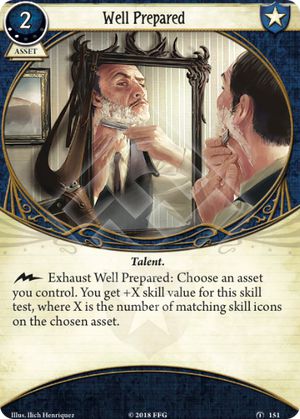
Gearing up for True Solo

Deckbuilding principles for a True Solo investigator

In this post, I explained that unlike for multi-investigator play, a True Solo deck must address all the challenges of the game. Your deck should be able to gather clues, to manage enemies and defeat some of them, to have enough soak / treachery mitigation to not die, to move, to pass a few difficult skill tests, and on top of it to do so while being as action efficient as possible. In this post, I propose some guidelines to construct decks that are likely to perform well in true solo.

A lot of the guidelines here could be applied at any investigator count, of course, but I will try to focus on  the specifics of True Solo.

I thought about everything I would need…
… and I took it.

A deck start with an investigator card

This may be obvious, but the investigator card matters quite a lot when deckbuilding for True Solo (as it does at any player count). An investigator card bears the following elements:

  • Deckbuilding requirements: size of the deck and allowed cards. Also gives the required signature and signature weakness.
  • Skills: willpower, intellect, combat and agility.
  • Health/Sanity: damage and horror an investigator can take before being defeated.
  • Ability: special rule unique for the investigator.
  • Elder sign: value of the elder sign token & effect that trigger upon drawing it.

Skills

Let’s start with the skills: willpower is by default a largely defensive and reactive stats. Without specific card use, it is mainly tested by the encounter deck treacheries. Intellect is on the opposite, a completely pro-active stat with the main purpose of gathering clues with investigate actions. Combat is a mix of defensive and pro-active, as investigators mainly fight to not be defeated, but it is also sometimes required to defeat an enemy to gather XP or advance the act. Finally, agility is natively a purely defensive stat, that helps passing tests on treacheries and manage enemies through evasion.

Looking at an investigator skills will give valuable information on how your investigator will perform the challenges of the game. The average difficulty of a skill test in Arkham LCG is around 3, and investigators should be able to take most of the tests they want to pass with a +2 to +3 margin, as it gives a good success chance and prevents most of the effects of the symbol tokens from triggering in standard difficulty. They also make retaliate and alert effects not likely to trigger. The skill value you should be aiming for if you want to repeatedly test a skill is therefore at least 5-6.

Investigators natively starts with a skill value between 0 and 5. A 5 means that the investigators is almost ready to perform without any further skill boosts. A 4 can be easily boosted with a couple assets. 3 is the turning point, where boosting a skill to be reliably taking tests requires a lot of set-up and investment. Bellow 3, the investigator should avoid actively using the skill if possible. This can be done either by cards that grant automatic success on a task (guaranteed clue, guaranteed damage, etc.), or by cards that allows you to test another skill for the same result (mystic spells, Thieves Kit, etc.)

For reactive skills (mostly tested by treacheries), the same principle apply, but the number of skill tests to pass should be smaller over a scenario. Using skill cards instead of assets is a good way to pass a few tests of a skill you are not actively using. Investigators with very low reactive skills (1 and 2) should either turn to treachery cancellations, mitigation effects, or very large skill boosts (such as Promise of Power).

Health and Sanity

Most investigators have a total of health and sanity between 12 and 16. However, some investigators can have as low as a 5 in health or sanity. As treacheries that test willpower commonly inflicts horrors and the ones that test agility do damage, an investigator with a low willpower and sanity or agility and damage probably need some support to prevent being defeated by the encounter deck. That support can take the form of extra soak, heal, or more ways to defuse treacheries.

Deckbuilding requirements:

If the skills of investigators determines which skills they want to use and the one they want to workaround, their class access dictates how they can do it.

Guardian cards offers reliable weapons to fight using combat, some cards to get clues without tests, and numerous soak and healing options.

Seeker cards offers lots of ways to improve clue gathering. There is no assets (except for Strange Solution-Acidic Ichor) in the seeker pool that offer you to fight using a test of any skill. They however have some options for guaranteed damage dealing and a few events to fight with intellect. Seeker have also less soaks but numerous healing options.

Rogues have access to weapons to work with medium stats, and a lot of cards to transform agility in an active stat. They also have a lot of options to use resource to pay for guaranteed effects.

Mystics are built around using willpower for every types of tests, and their card pool is a good reflection of that.

Survivors cards are design for use with low to medium stats, and to mitigate the negatives or even take advantage of failed tests. They also have access to some of the best soaks assets in the game.

Deckbuilding requirements, combined with skills, should allow the player to create a coarse strategy for deckbuilding. As an example, a seeker 0-5 with 4W/5I/1C/2A (wink wink Harvey) will probably be fine for clue gathering and horror protection, but will need to use a lot of deckspace to reliably manage enemy, and probably a bit of damage soak and healing.

The investigator signature card(s) and weakness(es) are worth taking into account. Some of them will be impactful enough to shift your deckbuilding to either profit from your signature, or to deal with your weakness.

Investigator ability

While stats and deckbuilding requirement are essential for deckbuilding, the investigator ability has a more variable role. Some investigators are essentially defined by their ability (Hello Calvin , Charlie, Amanda), and their deck should be built around it. Most investigators however have an ability that will improve the value of specific cards and playstyles, and a few have an ability that has either a minor impact if not being a drawback (Jim, Lola).

It is often harder in True Solo to get the full value of an investigator ability. The need for a versatile deck prevents to maximize the synergies with the investigator ability, and it even sometimes a trap to do so.

Elder Sign

While it is always nice to fish it during a game, it is often too inconsistent/minor to be worth deckbuilding around. Father Matheo might be one of the rare exception because is elder sign effect is so strong it is worth considering.

Assets, events and skills

Assets, events and skills fulfill different purposes, and their balance is not the same in True Solo or multiplayer.

  • Assets are usually a tempo loss when played, but improve your game state for a few turn, if not until the end of the scenario.
  • Events are one-off effects that have a strong impact on game state, but their cost can be high.
  • Skills are tied to a test, just cost a card to play, and have an instant effect on the game state (usually lesser than an event).

True Solo play does affect the relative balance of how many of each a player should include in a deck. To have 80% chance of getting a weapon after the mulligan, one needs 4 weapons in the deck. As a multiplayer fighter, that would be enough. But as a solo investigator, one might now need assets to boost investigations. To have both early in the game, we are now looking at 8 assets in total. And that’s not accounting for allies or extra soak one might want to include.

One could argue that fighting and investigating can be assisted by skills and events. It’s true, but less effective in True Solo. 

First of all, events are great at crisis management and creating big game state changes. In True Solo, a lot of events fade because the effect is too big for the situation and not worth the cost. The likelihood of a Dynamite Blast or a Pilfer paying of is reduced playing solo. 

Secondly, the pacing in True Solo is a succession of quiet turns and crisis managements. Quiet turns are great to put assets in play and favor these. And while events are great at crisis managements, that is assuming you are holding in your hand the right event for the situation. And a team of four holding 5 cards each is much more likely to have a suitable answer than a lone investigator. Moreover, some events require a skill test, and if you have no back-up, a single miss can turn a stable situation into hell.

Events are also eating a lot of deck slots. A solo player can expect in a 15 round scenario to draw an average of 4-5 enemies. Even assuming the player would have a fight event for each of them, it is still rare to find 5 events that can one-shot an enemy. With the possibility of failure, if one was only fighting with events and never evading, it would require at least 7-8 cards to do the job (compared to 4 weapon assets). On top of that, events are pricy, and having the economy to sustain them would lock even more deck slots.

Skills suffer from a different issue. While they are free to play and need no support, their effect is usually minor. They usually help the player pass a test, with a small bonus on top of it. Vicious blow is a great skill, still worth packing in True Solo. But a .45 automatic packs the effect of 4 Vicious Blows in one card slot.

There is certainly tests you need to pass in True Solo where a skill might be the best answer. Scenario Tests are a good example, and Treacheries tests might be another. For this reason, I tend to favor having a few key skills to help passing targeted tests, rather than good generic skills.

The overall result is that True Solo decks, in my experience, tend to be on average a bit more asset heavy than in multiplayer.

Slots matters

In the previous section, we saw that a True Solo deck is likely play more assets than the average. But there is only so many slots to fit these assets in. 

An issue arises when an investigator uses multiple assets to perform different tasks in the same slot (most commonly hand slots, or arcane slots for mystics), as their competition for the slot might prevent you to have the asset in play when you need it, or will require discarding an asset you might need in the future.

To prevent this, players can use three distinct workarounds:

  • Creating/Changing slots: more and more cards let the player manipulate their slot distribution. The first was bandolier and many other followed. They do however have a significant drawback. They are an added cost to an investigator set-up, and might constrain the set-up order. Even a card as good as Tinker, still cost one resource and a card to address an issue you might have been able to avoid.
  • Using no asset to perform one of the tasks type: as it was discussed in the previous section, using only events and skills to support a role creates other issues. But some investigators have an ability that support it or access to card packages that makes it viable. Kymani Jones might for example be able to ditch fighting assets, as they can discard most enemies with their ability.
  • Distributing tasks type among different slots: this is my preferred solution. In a complete card pool, fighting, healing, skill boosts can be found on many slots other than hand slots. The Edge of the Earth spell suite gives non mystic investigators options to fight/investigate/evade/heal with their arcane slot. The Scarlet Key investigator expansion gave mystics decent hand assets to do the same. The Feast of Hemlock Vale introduced some cards that investigate with an accessory slot. Skill boosts can come from almost any slots. Be creative.

Deck construction checklist

Creating a deck should take players through these steps:

  • Step 1: evaluate how good the investigator is at addressing each challenges of the game
  • Step 2: add cards to help the investigator to address every challenges
  • Step 3: Evaluate how good is the investigator with the current deck to address every challenges
  • Step 4: if one aspect is lacking, swap cards and return to Step 3 until satisfied.

Step 3 is the step that require the most player skill. Here are some questions that I use and might help in evaluating other True Solo decks:

  • What is my ideal turn 1? 
  • How likely am I to survive a 3-4 health enemy coming on turn 2?
  • Can I manage 4-5 enemies across the scenario. Can I defeat at least 4-5HP worth of enemy?
  • Can I reliably collect 6-8 clues across the scenario?
  • Do I have a way to pass one/two skill test of difficulty 3-4 for any skill?
  • What does my full set-up looks like, how many resources / cards / action do I need to achieve it? Am I able to afford it?
  • Am I likely to die through damage/horror from the encounter deck?

Once I have a positive answer for all of these question, I usually have 20-26 cards locked in the deck. The remaining cards slots can be used for :

  • Extra value : using cards with specific synergies with your investigator, or generally good cards that provide action compression (Shortcut).
  • Extra consistency : just more of what you already have. Extra Vicious blows, Perception/Deductions, cards that draw cards.
  • Campaign tech: some cards can trivialize some of the challenge of many scenarios. If you have some knowledge about the campaign you are preparing for, you can use the remaining card slot for a few tech card (Fine Suit, I’m outta here, etc.).

Deckbuilding process example: "Skids" O'Toole

I wanted to at least provide one example of a deckbuilding process for True Solo. “Skids”, because he has a very straightforward ability (if it can even be called an ability), offers a good example opportunity.

Let’s start with Skid’s investigator card:
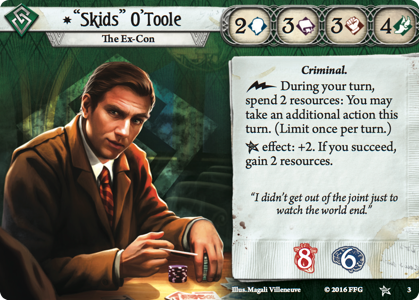
I know you all love me

His statline is challenging to start with. 3 in intellect and combat will require support if we want to use these. 4 in agility let’s us have a chance at evading and good mythos defense, and with 8 health dying by damage is unlikely. 6 in sanity and 2 willpower makes him quite susceptible to horror and annoying treacheries such as Frozen in Fear.

His ability is almost blank. Yes, it does mean having a bit too much of economy will not be a waste, but no reason to start the deckbuild around it.

His signature is a good panic button to by a safe turn, with great icons otherwise. His weakness is just an economy tax. His elder sign is great, granting us either 2 resources or an action thanks to Skids ability.

His deckbuilding, 5 Rogue/2 Guardian should offer plenty of weapons to work with, but boosting intellect might be a bit more difficult to achieve.

So, where to go from there. Fighting shouldn’t be too much an issue. Yes, 3 combat is not great, but the class access means that will have plenty of weapons, events and skills to fight with.

Getting clue consistently will be more difficult. We have little access to direct stat boost, and events that gather clue in guardian and rogue are either conditional to having an enemy around, or expensive. Our best option is to use a hand asset. At level 0, our options are flashlight, thieves’ kit, and lockpicks. Lockpicks are too likely to break at level 0. Flashlight is almost guaranteed three clues on shroud 1 & 2 locations and offer an effective +2 on higher shroud locations. Thieves’ kit gives us an effective+1 and should at least pay for itself. Let’s lock these in. 

Since we will be only effectively using our agility to investigate, it would be great if we could use the same stat for fighting. Short term, our only option to fight with agility is the British Bull Dog. Even if we can evade, two weapons with 6 total ammo might not go through a whole scenario, so another level 0 weapon is desirable. Machete, .45 automatic or the Mauser C96 are all good options here. Let’s got for cheap cost and go Machete.

We now have 8 assets locked-in to fight and investigate consistently. With these, Skids can investigate and fight with a skill value of 4 (5 with Flashlight). While it’s still to low to be reliable, we have plenty of room for support. Wolf Mask gives us rechargeable +2 combat or agility, which is almost exactly what we need. Taking two of these for redundancy.

It’s a good time to talk set-up. On the first turn, we would like to have at least a weapon (cost 3), an investigate tool (cost 2-3), and ideally our mask (cost 1). This adds up to a cost of 6-7. Since these are all items, Geared-up appears as a great option to bring the cost of each down and accelerate our set-up.

Now that we can fight and investigate reliably, we still need to find ways for Skids to survive willpower based treacheries and horror, and to pass a few key skill tests. 

With some XP, we do have plenty of options, the best being Savant and Counterespionage. At level 0, we have the options of the Tennessee Sour Mash, Guts, Take the initiative, and Say your prayers. The Sour Mash, even if it is an item, is too costly for only two +2 boosts. We will take the six skills. Take the initiative can also be used to pass a scenario intellect skill test (agility and combat being covered by the mask).

That puts us at 10 assets and 6 skills, and we start to have all of the main challenges covered.

Our game plan involves playing two hand assets and if possible a mask in the first round. That will deplete our resources, so it is unlikely we can afford another early big asset.

We do still however have a valuable ally slot to fill. Since we are not likely to have it early, we want an ally that is worth playing later on. I do like Venturer. It can restock our investigate tools and weapons, and is expendable soak (both effect that will be useful if we play Venturer mid game). An alternative would have been Gregory Gry, with the plan to use its resource generation to generate actions before killing him, but I fear that Skids will not be oversucceding enough to take his resources quickly enough.

With these 18 cards, we have good answers to all of the main challenges of the game. We are now looking to round up the deck with action compression, value and consistency.

Here are some good options:

  • Tinker/Bandolier: offers flexibility to have both weapons or investigation tools in play at once.
  • Cleaning Kit: item, same role as Venturer, minus the soak. A bit expensive.
  • Ancestral Token: sanity soak and bless generation. 
  • Faustian Bargain, Bank Job: resource generation to help deck economy, pay Skids weakness or to convert to actions.
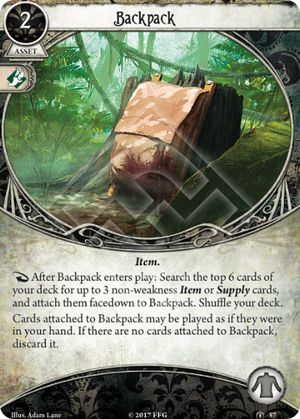
  • Backpack: item, card draw
  • Manual dexterity, Nimble: skills that boost our thieves’ kit and British Bull Dog, while providing card draw and move actions.
  • Leather Jacket/Trusted: fast extra soak.
  • I’m outta here: tech/panic card with two agility icon.

An example final decklist can be found here. It is certainly not the only build for True Solo Skids, but gives an example of what the deckbuilding process looks like. I also want to mention that this deck was purposely constructed without In the Thick of It and Charon’s Obol, as they deserve discussions of their own. It was also not tailored for a specific campaign.

Devil is in the details

I tried to provide in this post guidelines to build a sound True Solo deck for most of the standard investigators. Some investigators are define more by their ability than their statline, and their deckbuilding should account for that.

In later posts, I will review the card pool and evaluate, for each challenge of the game, the options given to the players. This will be part of a post series called: True Solo Toolbox.

Leave a Comment

Your email address will not be published. Required fields are marked *

Scroll to Top