Introduction
In the “5 cool cards to…” posts series, I look at the card pool for the most interesting cards to assist in rounding up a deck that might struggle with some of the challenges required to perform well in true solo.
To keep the posts to a reasonable size, I select cards with the following rules:
- 5 cards maximum per class
- Level 0-2 cards (to maximize the investigators that can access them, and facilitate the use in starting decks)
- Variety of archetypes (to avoid shoehorning players into one deck type)
- Suited for true solo (some cards have amazing value in 2+ players, but are less interesting playing solo).
How to get clues with low intellect
To perform in True Solo, any investigator must be able to gather clues reliably (my estimation is that around 6-8 clues per scenario). Having a low starting intellect means either spending a lot of your asset slots, resources and cards to boost intellect, or working around by having ways to get clues by other means. Usually, investigators with 4+ intellect will favor using the skill. At 3 intellect, both options can be considered, while with 2- intellect, it is usually best not to use it at all.
In this post, I will focus on ways to gather clues whatever the intellect value. Without further ado, let’s look at the cards.
Neutral cards
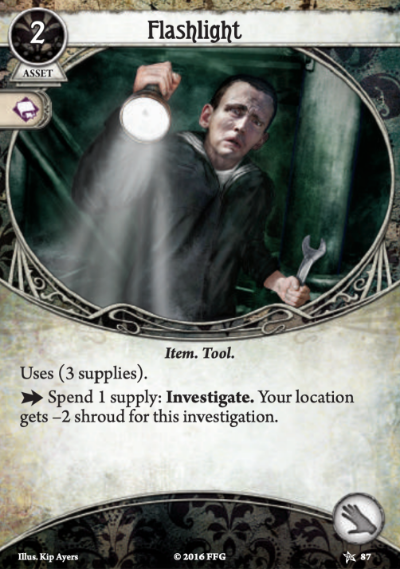
Flashlight / Archetype: Test at 0
Flashlight is a staple card in True Solo, as it can be selected by any investigators and can almost (autofail excluded) guarantee 3 clues out of locations with shroud 1 or 2. It also combines very well with other shroud reduction effects to tackle more challenging locations. A lot of cards can refill the supplies if needed.
The main drawbacks of flashlight are that it makes playing two handed weapons difficult, and the tempo on the card is not amazing (1 card, 2 resources and 4 actions for 3 clues is not the best).
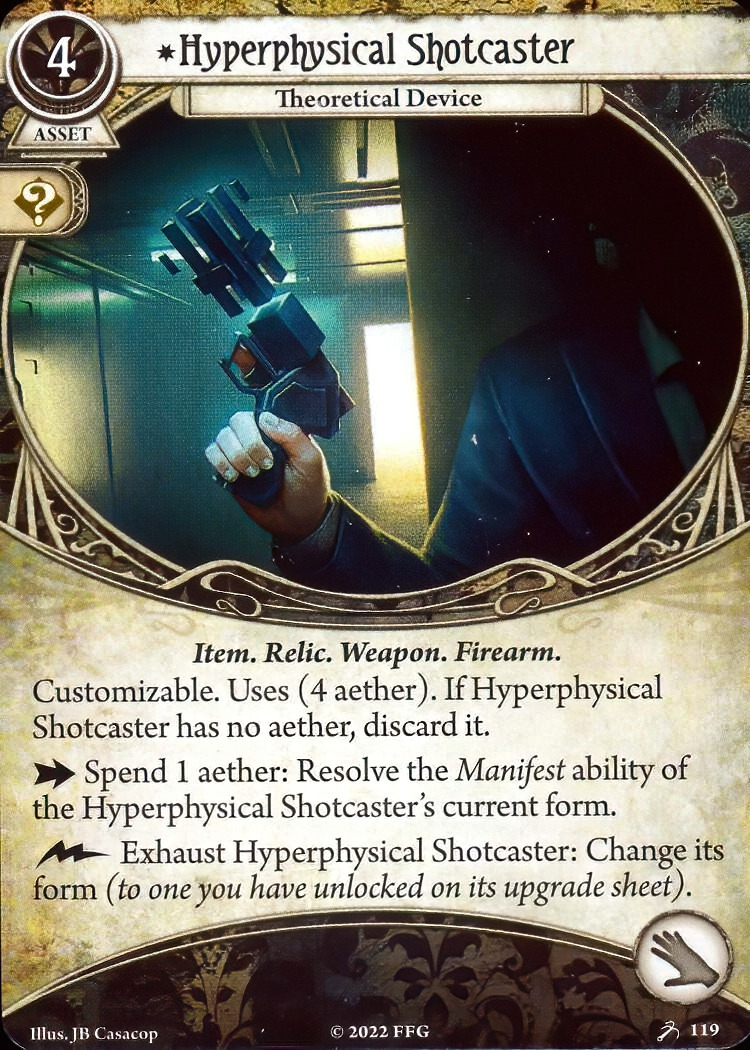
Hyperphysical Shotcaster / Archetype: Use another stat – Mobility Maters
While dubious flavor-wise, Hyperphysical Shotcaster, with the Telescanner upgrade can be a decent alternative to Flashlight. The XP cost and the lack of stat boost is somewhat balanced by the option to investigate from a distance, which opens up a lot of interesting play options.
It is best for investigators that have a native 5 in another stat, and intend to use it as much as possible. The main drawbacks are the resource cost, the slot, and the fact that refilling it is impossible without discard recursion.
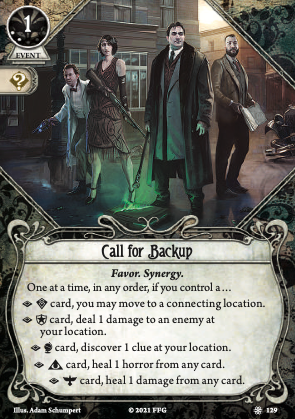
Call for Backup / Archetype: Synergy
Of course, this card can only get clues if you are controlling a seeker card.
The classes that make it playable are Rogue and Seeker, as a move and a testless clue for 1 card, resource and action is both decent value, and very easy to benefit from in true solo.
To really justify the XP cost, though, it is probably only worth including if you have a decent chance at triggering a third effect. But it is easy enough to achieve for a good number of investigators, and with multi-class cards.
Guardian Cards
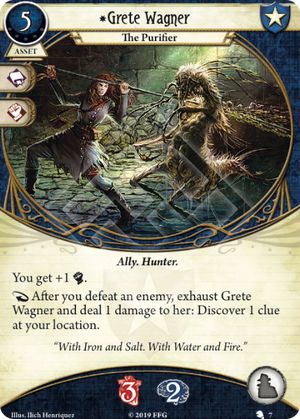
Grete Wagner / Archetype: Enemies matters – Healing matters – Meat army
Grete is a great selection at level 0 because it both support fighting, and can provide clues with the caveat that you need to defeat enemies on a location with a clue on it.
An investigator cannot count on Grete to solve clue-getting on her own, but she made the list because the opportunity cost of playing her is low. If you have enough enemies, Grete can deliver two clues without leaving the board, more if she can be healed.
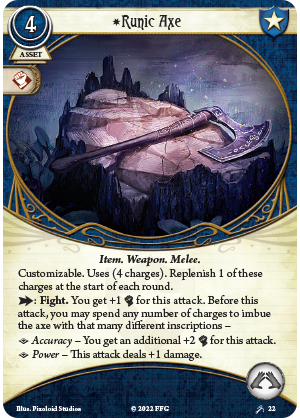
Runic Axe / Archetype: Enemies matters
Runic Axe, with the Inscription of the Elders, can deliver a clue when oversucceeding a fight test. The main selling point is that the Axe is on its own a primary weapon that can be upgraded until a campaign finale, and this upgrade is dirt cheap. Defeating the enemy is not required, which can open some cool tricks with move effects such as Shortcut
Because the investigator need to oversucceed by the shroud value, it is best for investigators with already high base fight.
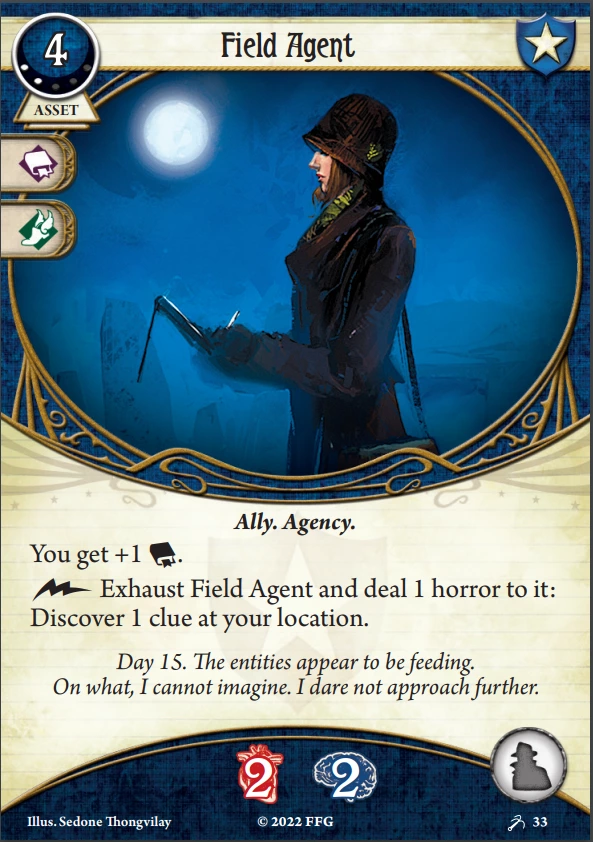
Field Agent / Archetype: Healing matters – Meat Army
Field Agent is an odd duck, as she boosts the stat you want to avoid testing. But the ability to fast-out a clue of a location without a test or action is very strong.
The cost is way to high to justify if you are not getting more than two clues, though. Having ways to either heal her (such as the Hallowed Mirror), or to increase her stats (with the like of Trusted/The Star) are the way to make her shine. At 2 XP cost, you however cannot rely on Field Agent to get clues in early scenarios.
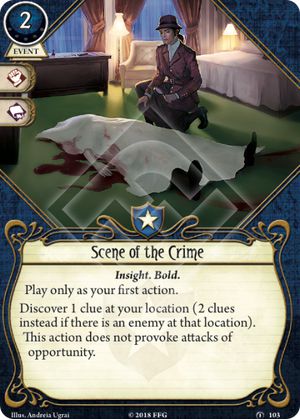
Scene of the Crime / Archetype: Enemies matters
If there are two clues and an enemy on your location, this card is great. In True Solo, this is unfortunately not likely to happen. The main reason to play this card is that, sometimes, it is the only option available to “get a clue, no question asked”.
The rate on this card is poor, but at least, you always get the clue, and some investigators with limited deckbuilding options just need these kind of effects to round up their decks.
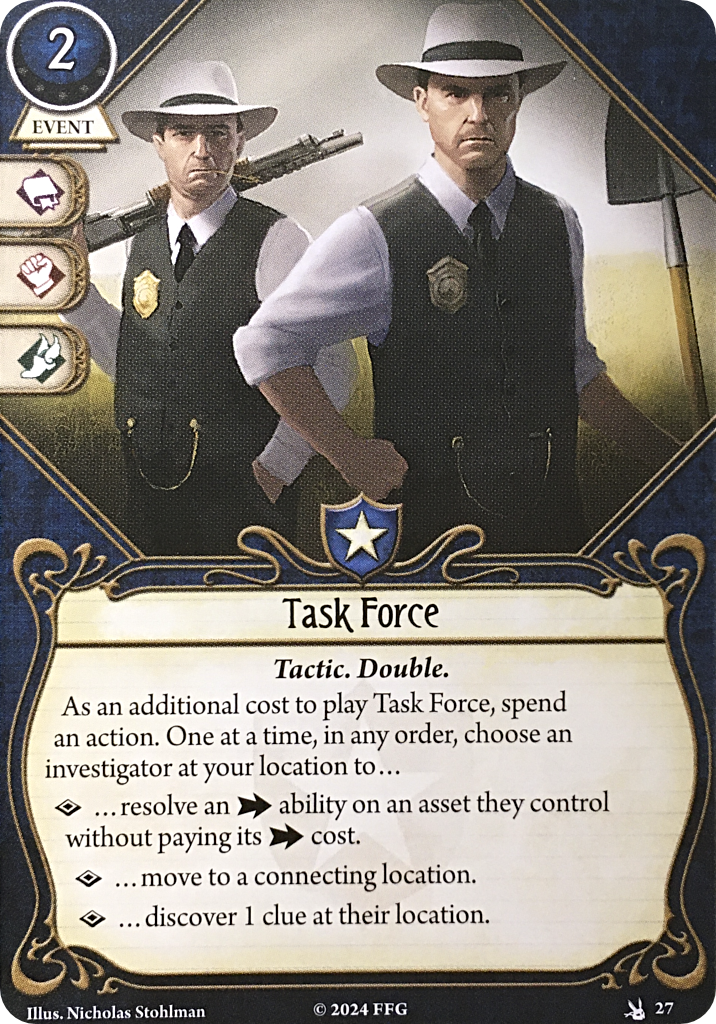
Task Force / Archetype: None
Task Force fills a similar role than Scene of the Crime, as an expensive way to get a guaranteed clue.
You are paying double the action cost, but it is quite common in True Solo to want to move and get a clue on the same turn, which makes the card a decent pick-up for investigators without other options.
Triggering the third action might be difficult, but has some use such as triggering a Flashlight before/after moving, fighting after moving, or activating a Discipline with Lily Chen.
It appears clearly that Guardian is not the easiest class to get clues with. A lot of their cards care about having enemies around, which in Solo might be difficult to reliably achieve while having clues on the location.
Notable honorable mentions: Evidence, Guided by Faith
Seeker Cards
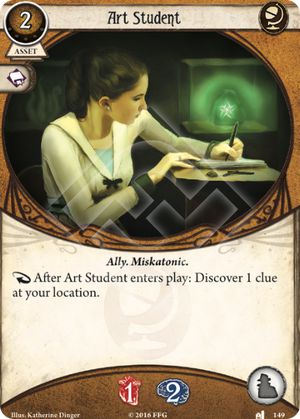
Art Student / Archetype: Meat Army
Art Student is another card that just guarantees a clue. The card, action and resource cost are decent given that it also grants decent soak on top of it.
The ally slot is a tough ask, though. This card fits most in decks with multiple ally slots, that plan to actively cycle through allies using them as disposable soak.
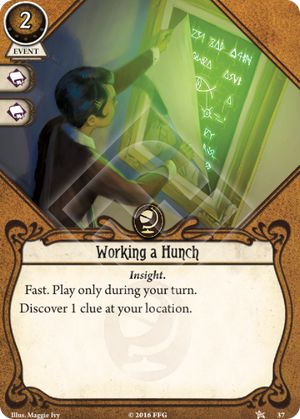
Working a Hunch / Archetype: None
Get a fast clue, no question asked. It is by far the most versatile way to guarantee one clue, at the cost of two resources and a card.
Nothing is exciting about this card. The rate is fair, and can provide a way to bypass high shroud locations or annoying treacheries. The main drawback is that it is still using a card slot in your deck for a single clue. Yet, it is a card I frequently use for investigators that struggle discovering clues.
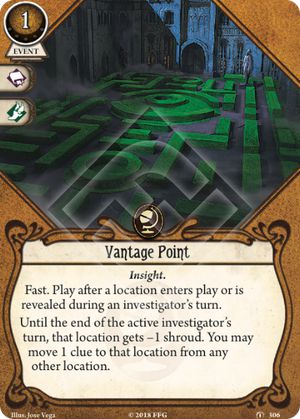
Vantage Point / Archetype: Test at 0, Clue manipulation
It doesn’t technically discover any clues, but yet made the list.
I do like Vantage Point as it opens very interesting play patterns. You can use it to empty a Victory location without a test, or bring clues out of locations blocked by enemies/treacheries. It can also guarantees that the location you enter will have two clues on it, to maximize the effect of other clue gathering events such as Read the Signs or Look What I found. Finally, the shroud reduction can be used to bring a Shroud 1 (or 3 with a Flashlight) location to 0, or even to get a discount on Lola Santiago ability. Fun card!
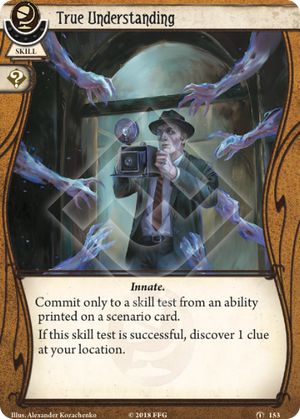
True Understanding / Archetype: Tech
This card is quite interesting, as it can provide a fast/free clue. It is cheaper than Working a Hunch, and can assist at succeeding on another skill test.
The main difficulty is finding the good test to commit this on. Some scenarios have locations or Act/Agenda cards with printed test on them, an you can use True Understanding as a tech for them, but the most common use is during the Mythos phase on a treachery test. This is why this card is good for investigators with good defensive stats to start with.
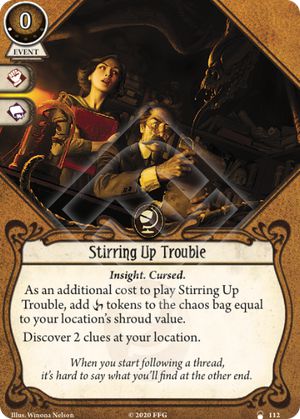
Stirring Up Trouble / Archetype: Curse
Two clues is enough to clear most of the locations in True Solo, and a few curses to pay for this is not a big deal.
This card is one of the “instant value” cards that loads the bag with curses in exchange. But curses in True Solo are far easier to profit from than in a full team of 4. Blasphemous Covenant alone completely shuts down the drawback for curses in the bag.
This card is great for X-5/Seeker 2 investigators, combined with Tempt Fate and Blasphemous Covenant, and a staple in a cursed Luke Robison build.
While Seeker investigators usually have high intellect and can go the “book vs shroud” route, the class still offers many and quite diverse options to get clues without testing intellect for other investigators with access to them.
Notable honorable mentions: Control Variable, Extensive Research
Rogue Cards
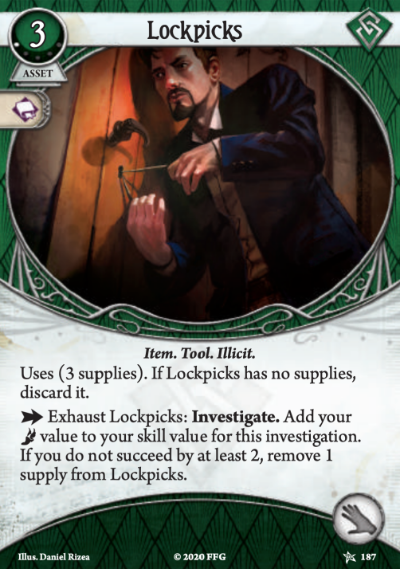
Lockpicks / Archetype: Agility matters – Over succeed
Lockpicks(1) is the staple clue getting asset for Rogues. Any Rogue except Tony Morgan will investigate with at least 6 skill value. The 3 supplies makes Lockpicks(1) way less likely to break than their level 0 counterpart. The exhaust condition is also less impactful in Solo, as most locations only contain one clue, and a clue per round is an ok pace to go at.
Adding two stats has the additional perks of having an easier time triggering all the over-succeed effects that Rogues like. For a lot of investigators, the only reason not to use In the Thick of It to get two of these at the beginning of a campaign is the existence of the following card.
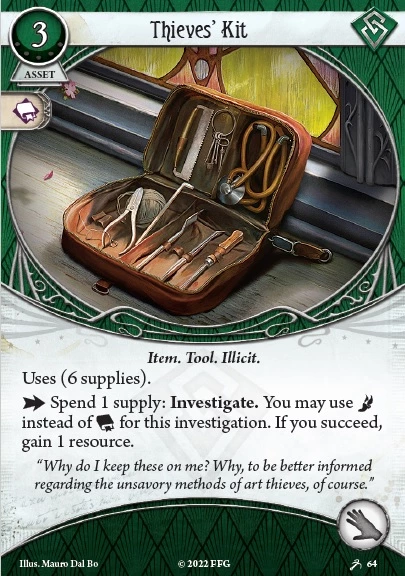
Thieves’ Kit / Archetype: Agility matters – Big Money – Spend Money
Thieves’ kit is an interesting substitute to Lockpicks(1). Unlike Lockpicks, it does not push the stats as high, allowing most Rogues to investigate at base 4-5. It also has limited uses.
On the plus side, though, it requires no XP to slot in, and can turn into a resource engine if you have high enough agility. Depending on the direction you want the deck to go, this can be upgraded to Lockpicks(1) or Thieves’ Kit(3), or co-exist with Lockpicks(1) for redundancy.
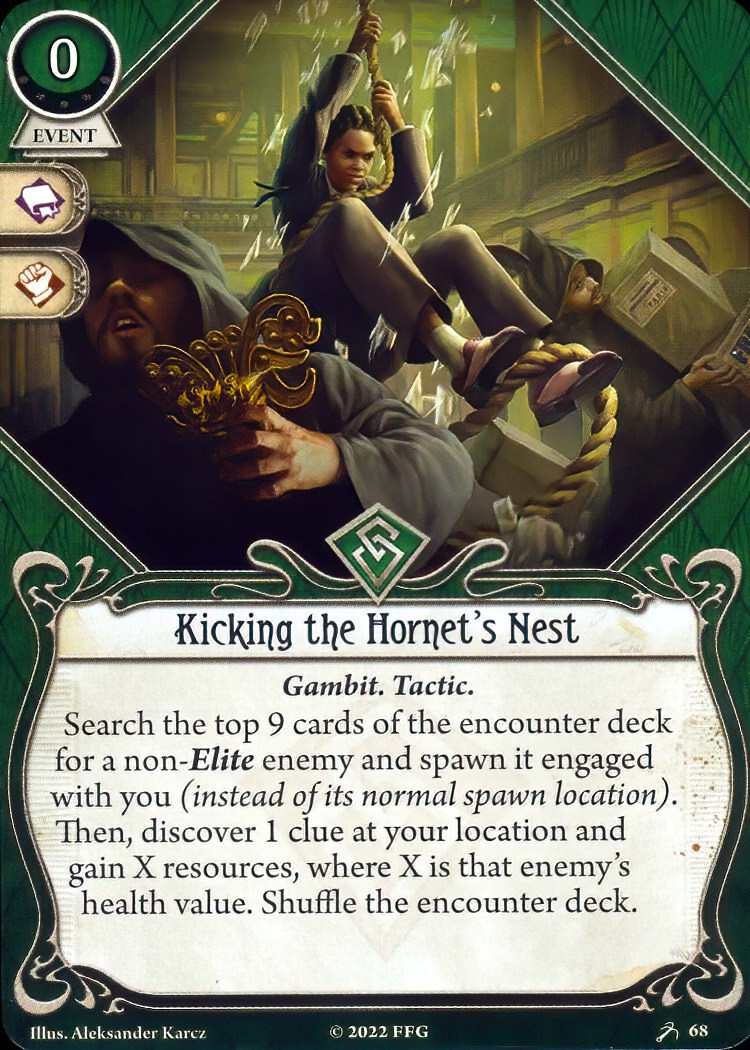
Kicking the Hornet’s Nest / Archetype: Enemy matters – Parley – Big Money – Spend Money
This card grants both resources and a clue, at the expense of putting an enemy into play. For most investigators, in solo, this is not a good trade. But a fair number of Rogues have ways to mitigate the draw of an enemy, or profit from it. Trish can auto-evade the enemy or get an additional clue, Finn gets a free evade action to deal with it, Alessandra has a whole bunch of parleys that need an enemy around, etc.
This card can also support good fighters such as Tony or Mark to turn their fighting power into clues and economy.
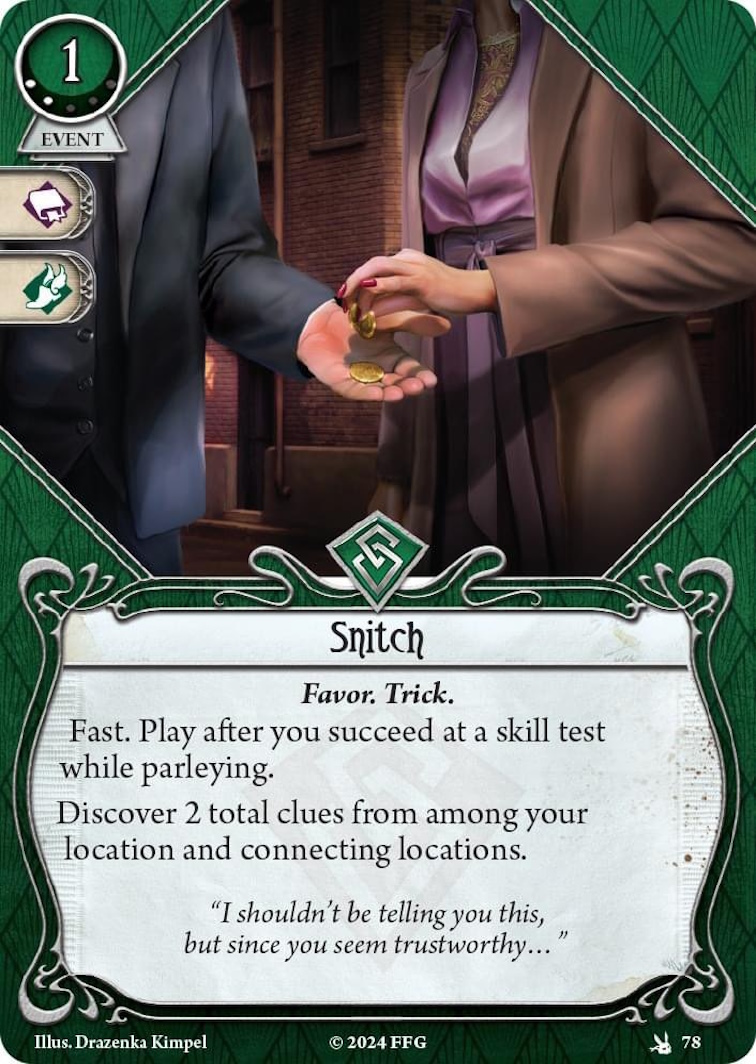
Snitch / Archetype: Parley
Snitch has a narrow use, but great value in this use. With the Feast of Hemlock Veil expansion, Rogue got a whole lot of very good parley cards, such as Grift or Steer the Pot(0). Snitch is a great payoff card for these events, and the ability to scoop connecting locations makes it way easier to play at full value in Solo.
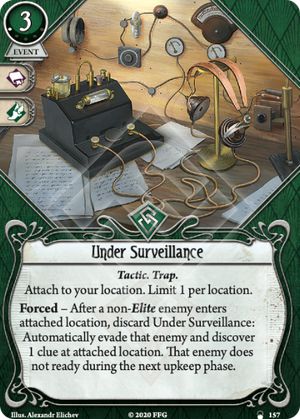
Under Surveillance / Archetype: Trap – Spend Money – Tech – Enemies matter
This card is my personal choice for a more niche card, yet very potent. It is costly, and the one XP to buy it stings. However, being able to freeze an enemy is very powerful, especially True Solo.
This card provides a good safety net if you need a break to set-up, or to toss a bunch of parley effect without risks. Knowing the scenarios can help to guarantee a fast trigger, but Rogues also have multiple ways to send an enemy into the desired location should you need to.
Rogues have many ways to get clues without testing intellect. But the substitutes they use are quite diverse. A lot of cards care about agility, and some are played around enemies. Some cards even allow to just spend resources to get clues.
Honorable mentions: Breaking and Entering, Intel Report, Vamp
Mystic Cards
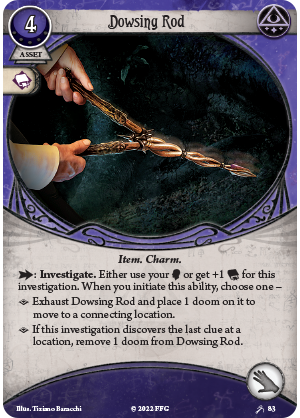
Dowsing Rod / Archetype: Will matters – Doom
Dowsing Rod is quite a good card in True Solo. It gives the ability to investigate using willpower, and provide some action compression along the way. It has also the advantage of freeing a mystic arcane slots for other spells, and has unlimited uses.
It might be difficult to benefit from the free move on every location, because clearing the doom is not that easy with only one clue per location, but even if it just saves 2-3 move actions in a scenario, this is already quite good.
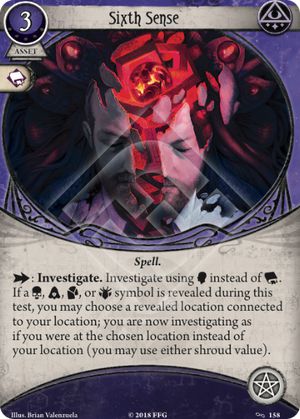
Sixth Sense / Archetype: Will matters – Symbol Tokens
This card mostly reads as “investigate using willpower”. The main appeal in True Solo is that it is also an asset with unlimited uses. The rest of the text might once in a campaign provide some utility, but it could not be there and the card would be just as usable.
Compared to Dowsing Rod, it is a bit cheaper but takes the arcane slot and does not offer reliable action compression. However , because it is a spell, it beneficiate from mystic spell synergies (Arcane Initiate, Arcane Research, Uncage the Soul)
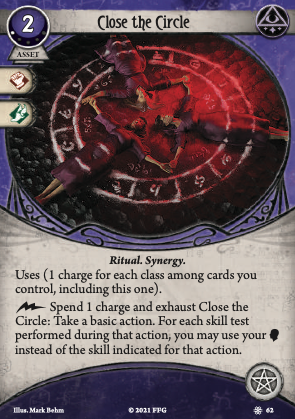
Close the Circle / Archetype: Will matters – Synergy
Close the Circle is an amazing payoff for an investigator with high willpower and playing a synergy deck.
Just as the cards above, this cards enable basic investigates with brain, once per turn. But the main appeal is to do it as an extra action. This card also is quite versatile, which is useful in True Solo. You could use the card to get extra moves, evades, or even basic fights to get rid of a cultist.
How good is the card depends on how many charges you can put on it. At 2, its fair but not worth the XP and arcane slot. 3 uses is a good start, and anything on top of that is amazing.
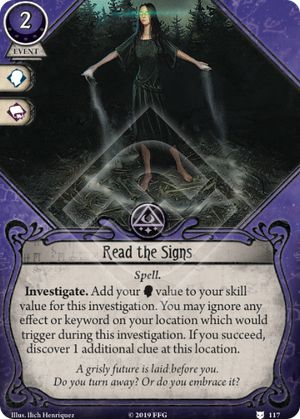
Read the Signs / Archetype: Will matters
In True Solo, most of the locations have only one clue, which devaluate the clue-compression assets such as Rite of Seeking. On the rare 2+ clues locations, having one event to compress the clue collection is a good strategy.
In this category, Read the Signs is in direct competition with Drawn to the Flame. It costs two resources more and the clues are not guaranteed (though often you will just fail on the autofail), but Drawn to the Flame has more variance, as it can be quite bad in True Solo to draw an enemy with only one or two actions remaining.
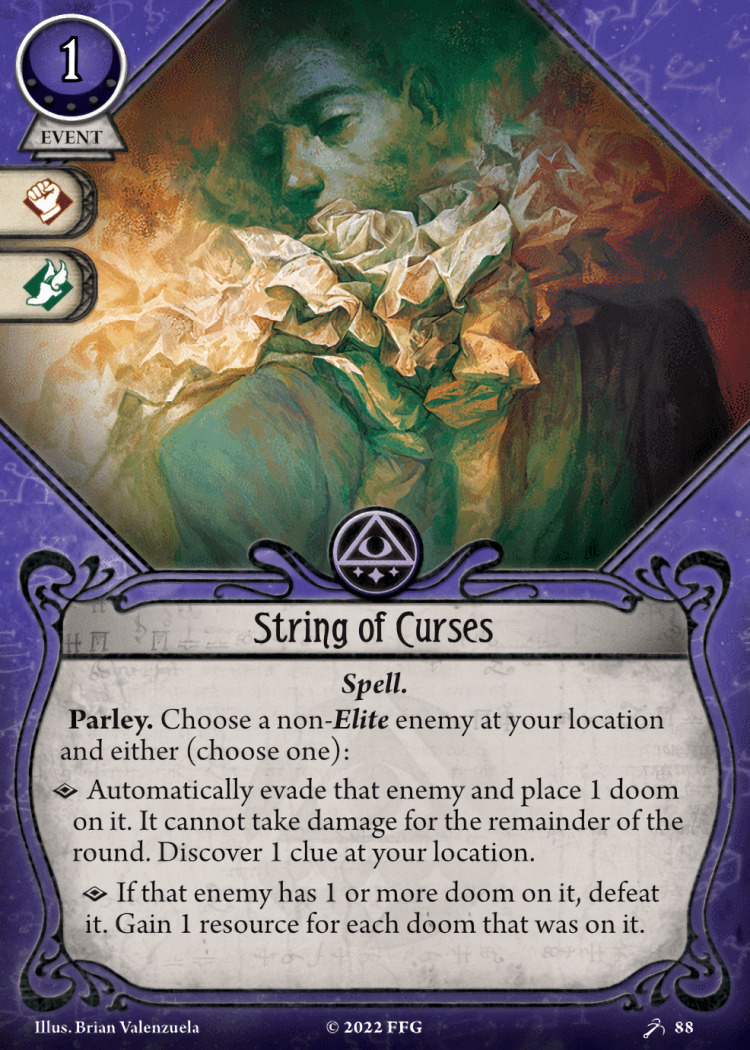
String of Curses / Archetype: Parley – Doom
The first option is the one that get the guaranteed clue, with the added perk of an automatic evade, and the extra cost of adding one doom on an enemy you cannot damage for the turn.
The doom is completely manageable, and the evade can save you if you need a break to reload a fighting spell. But this card turn silly good when using it with ways to play it twice in a round (Double, Double, Eldritch Tongue), as the enemy is now defeated (without any test) and refunds you the cost of one of the two uses.
Unsurprisingly, most of the mystic cards care about using a high willpower value to get the clues. For non mystics, events such as String of Curses or Drawn to the Flame offer interesting play patterns.
Honorable mentions: Drawn to the Flame, Divination, Summoned Hound, Summoned Servitor
Survivor Cards
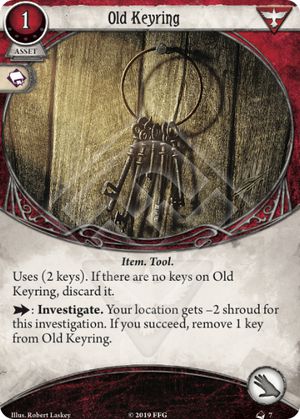
Old Keyring / Archetype: Test at 0 – Recursion – Fail forward
Old keyring is a cheaper Flashlight that can get maximum 2 clues, that can’t be resupplied, and discards itself once empty.
It is better than Flashlight if it is recurred, or played as a free action. In a deck aiming to investigate at 0, running both is probably good anyway.
Not using a key when the test is failed has also its uses, when aiming to fail a test on a 3-4 shroud location before playing a Look what I found.
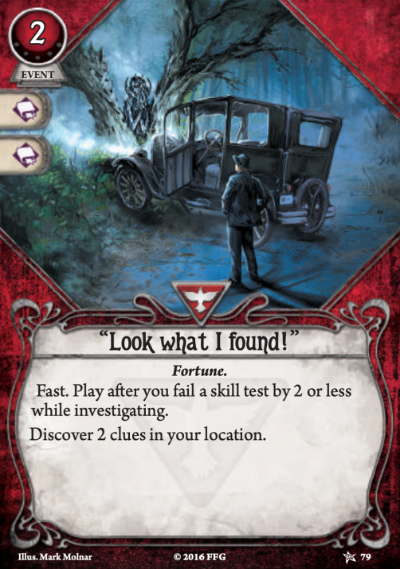
“Look what I found!” / Archetype: Fail forward
At its worst, Look what I found is a way to get up to 2 clues out of a Shroud 1-2 location, for two resources, a card and an action. Decent, not amazing.
The card however interact with a lot of other effects. Playing it in conjunction with an Old Keyring investigation enable clearing shroud 3-4 locations. The failed test can also be used to trigger Rabbit’s foot, Take heart, and so on.
It’s upgrade at level 2 is quite good as it as much more versatility, both in the shroud value that can be tackled and by enabling getting the clue on two different locations, which is quite useful in Solo.
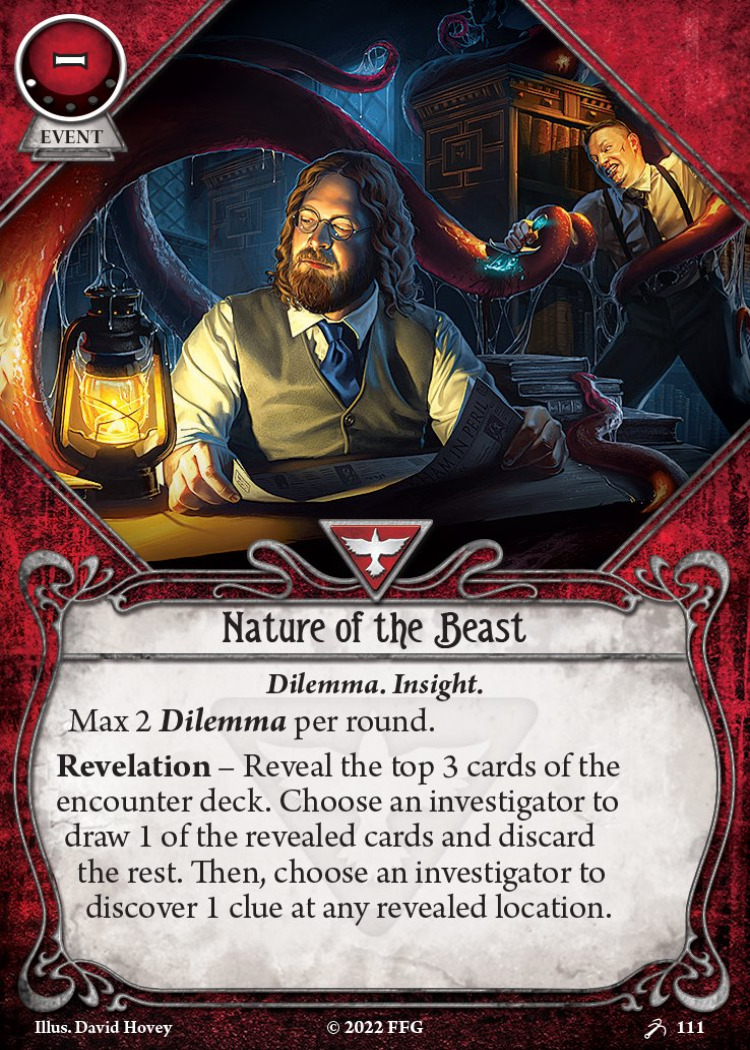
Nature of the Beast / Archetype: Dilemma
Getting a clue without passing a test or spending an action is undeniably good, well worth an XP.
For the downside, the tricky part is to avoid having no clues on the board when you draw the card. This is easy in some scenarios, where the investigator can just let one clue on the first revealed location, but more difficult in scenarios that require clearing the locations to move forward. In that case, timing the draws and moves accordingly is essential.
Running this card also means being confident at tanking a treachery, but it is usually quite easy for survivors.

Burn After Reading / Archetype: Deja-Vu – Tech
One action, two cards and a resource for two testless clues is good, but not amazing. Worth paying one XP once, but not each time it is used.
The reason this card made the list is because it allows fun deck manipulations for those who like to tech between scenarios. Getting to exile a level 0 card allows to swap it for another level 0 card for free after the scenario, which pays back the XP cost of Burn after Reading.
In a campaign finale, this can also buy you an extra turn if you really need it.
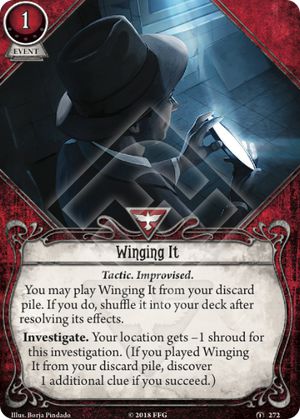
Winging It / Archetype: Discard, Test at 0
One action, a resource and a card to get -1 shroud on an investigation is just bad. Played from the discard, this card can however collect two clues from a shroud 1 locations for an action and a resource, which is great.
Playing this card requires a plan to actively use discarding cards as a resource (Readying Duke, Cornered, Wendy‘s ability).
For really low intellect investigators, a -1 shroud is not super versatile, as it limits which location can be investigated. Running this card along other shroud reduction cards (Flashlight(3), Gumption, Matchbox) is a good idea
Of all the classes, Survivor is the class where clue gathering is the most eclectic. The main strategy are to drop the shroud value to 0, to drop it to 2 and use Look What I Found, to raise the base stat or to straight up get clues in exchange for a negative effect.
Honorable mentions:
Gumption, Matchbox, Shed a Light, Augur, Mysterious Raven, Gravedigger’s Shovel, Trial by Fire
Outro
True Solo is about versatility, which some investigators are naturally gifted for.
For the others, whose base stats and ability favor strongly a given role, filling the other roles is more of a puzzle. This, in the early card pool, probably contributed to the “True Solo is difficult” assessment.
It is true that collecting clues reliably with investigators such as Zoey or Nathaniel Cho in an limited card pool can prove a serious challenge. But now, with an ever growing pool, more and more options open up for these investigators.
I would go as far as to say that there is now enough cards in the pool for every investigator to handle clue gathering reliably. The new challenge is to find which options are the most suited to the investigator you want to play, and which synergize the best with the rest of the deck.
To round up your deck, the primary goal is to get to a point where you can reliably collect clues. Optimizing the deck takes it a step further, as the goal is to look for cards that do it more efficiently, or can help to both collect clues and support another role.