Model for scenario difficulty

Toward a system to rate scenario difficulty

I am quite happy to write this article, as it feels that it is finally time to assemble a lot of concepts I introduced on this blog.

How can we use the player resource trade model to assess the difficulty of a scenario?

The whole idea of the resource trade model came from the fact that, from my humble perspective, the essence of the game of Arkham Horror LCG is about trading player controlled resources toward XPs and favorable scenario resolutions. 

But what makes the difficulty of a scenario? Is it the lack of player resources? The amount of tasks to complete to get XP/ get a good resolution? The encounter deck? 

The answer is some of each. In this post, we will create a difficulty rating based on evaluating what resources players gets to work with, and what they are required to do.

Trading resources …
… until the end.

Supply and demand

Definition of difficulty

Before moving toward quantitative values, we need to give a good definition of what our model difficulty is. I propose the following definition for difficulty:

The difficulty of a scenario is the ratio of tasks players need to perform to get to a favorable resolution, over the amount of resources available for them to spend and trade.

To me, this definition is the one that makes the most sense. Intuitively, having extra clues to find, move to perform, etc… all make a scenario harder, while being given more rounds, having extra cards (such as story assets) make a scenario easier.

The only thing that remains ambiguous is how to factor in the encounter deck. One could argue that dealing with the encounter deck is an additional task that the investigators have to perform, while another point of view is that the encounter deck takes away resources available to the player. Both are valid, but for our model, we will consider the later.

Resources available for players

What are the resources given to the players during a scenario?

First, they will start a standard scenario with 5 cards and 5 resources. On top of that, they have a health and sanity pool (usually of 14 total health/sanity), of which they can spend all but the last points without being defeated (so 12 total for most investigators).

This, in the resource trade model, equate to 5R + 5×1.5R + 12×1.5R for a whopping total of 30.5R.

Each round, they receive 3 actions (during the investigation phase), and one additional card and resource (during the upkeep phase). This equates to 3*2.5R + 1.5R + 1R =10R per round of play.

They unfortunately also receive an encounter card during the mythos phase, which takes away some of their resources (to either deal with a treachery, or manage an enemy).

The total amount of resources to be spent toward advancing the scenario for each investigator is therefore:

Supply = 30.5 + #rounds * (10 – (average encounter card rating)).

Tasks to perform in a scenario

EWhile evaluating the amount of resource available for player is relatively straightforward, evaluating what is required to succeed in a scenario is more complex.

First, Arkham Horror LCG does not have a clear “win/loose” resolution except for the end of the campaigns. Yet, their is often a good incentive to aim toward getting to the resolution at the end of the act deck. The path toward this resolution will be qualified as “Minimal success condition”.  Most often, this path will not reward the players with all the XP they can collect. the “Extensive success condition” will add both the tasks required to achieve the favorable resolution, and additional tasks require to maximize player XP.

So, what are the tasks that player have to complete?

– Collect clues to advance the act deck/clear VP locations

– Move between locations if needed

– Manage enemies not in the encounter deck (that can enter play through any scenario effect)

– Complete scenario actions

Each of these elements can be quantified in our model.

Collecting clues

Collecting a clue of a Shroud X location is, rating wise, equivalent to fight an enemy that can’t deal damage and can be defeated in one hit. This has a cost of:

This is in essence the minimum cost for the investigator that balance the cost of boosting the skill to a value where the chance of succeeding is high enough, vs the cost of the lost action when the test is failed.

For a investigator with base skill 3, and a standard night of the zealot bag, this equates to:

  • 3.1 R for a Shroud 1 location
  • 4.0 R for a Shroud 2 location
  • 4.9 R for a Shroud 3 location
  • 5.8 R for a Shroud 4 location
Any additional shroud point is an extra 0.9R worth.

Moves / Scenario action without test

Any action that need to be spent to advance the scenario and does not require a test is worth 2.5 R (same as a player action).

Scenario actions with a test

Scenario actions that require succeding at a skill test (such as parleys with story characters) are equivalent to getting a clue of a location with a shroud equal to the test difficulty

Scenario enemies

The rating of enemies outside of the encounter deck is established by the same technique as any other enemy.

From model to practice : true solo in The Gathering

Examples are always the best illustrations of models, and The Gathering is a scenario that serve as a tutorial for the game, which means its mechanics are straightforward and what needs to be done is easy to grasp. We will also limit the model for a True Solo investigator, to keep it as simple as possible.

Supply

Going through our modelling process, we first need to assess the amount of resources available for the investigator to use.

The Gathering agenda deck allows for 20 rounds of play (3+7+10). 

From the model before, that’s 30.5R+20x10R for a whopping total of 230.5R resources available for the investigator, of which we need to remove what’s taken away by the encounter deck.

The encounter deck is made of:

  • 3 x Ancient Evils
  • 2 x Crypt Chill
  • 2 x Obscuring Fog
  • 3 x Grasping Hand
  • 3 x Ghoul Minion
  • 1 x Ravenous Ghoul
  • 3 x Swarm of Rats
  • 3 x Rotting Remains
  • Dissonant Voices
  • 2 x Frozen in fear
  • 1 x Icy Ghoul
  • x Flesh-Eater
From the examples given in the posts modelling enemies and treacheries, we have a rating for each of these cards, and can compute the weighted average rating of the encounter deck, which is 3.9R for The Gathering
The remaining resources for the players, accounting for encounter deck management are 30.5+20x(10-3.9), for a total of 152.5R
Note that the encounter deck took away about a third of the player resources.

Demand

Now that we have the amount of resource the player has to work with, let’s consider the demands of the Scenario. First, we have to consider an objective. In this scenario, the best resolution is to defeat the Ghoul Priest, as it both grants XP and removes it out of the encounter deck for later scenarios. We will consider it as the goal for the scenario.
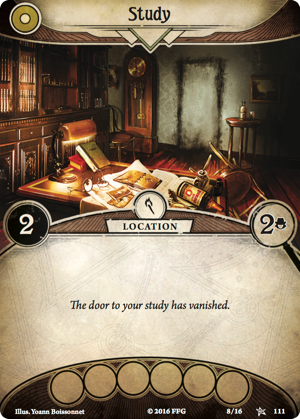
  • In Act 1, the only demand is to get the two clues out of the Study, a shroud 2 location. That, in our model, is worth 8R
  • In Act 2, the investigator must collect 3 clues to advance to Act 3. Their is two clue in the Cellar (Shroud 4) and Attic (Shroud 1). The easiest way to get 3 clues is to get 2 from the Attic and 1 from the Cellar, which is worth 2×3.1+5.8=12R. Moving to each of the locations and back to the Hallway will cost a total of 4 move actions, and the investigator will also take 1 damage and horror from entering the locations. This is an additional ask of 4×2.5+2*1.5=13R
  • In Act 3, the only thing to do is to defeat the Ghoul Priest, an enemy rated at 18.3R in Solo.
  •  As it is -almost- impossible to end the scenario before the Agenda 1 advance, the investigator will also have to choose between discarding a random card, or take two horror. That’s a minimum of 1.5R lost.
The total demand for the scenario is 8+12+13+18.3+1.5=52.8R

The Gathering difficulty rating

Now that we have the balance of scenario demand and player resources supply, we get to a difficulty rating of:

52.8/152.5 = 35 %

That is a number. But what can say about it?

A rating of 100% would mean that doing only “fair” trades of resources, an investigator would, on average, just complete the scenario using each of its resources available.

The Gathering, with such a low rating, leaves plenty of room to either end the scenario earlier, or make sub-optimal trades. The exact number will only matter when comparing it to other scenarios, but we can already say it probably lies on the easier side.

Another observation is that in our rating, we only included the demand to get to the resolution. This resolution will grant us the XPs from the Ghoul Priest and clearing the Attic, but their is another XP left for grab in the Cellar. To get it, we need to clear one more clue of a shroud 4 location, which would increase the demand by 5.8R, and the overall rating to 38 %

What about the effect of the number of investigators? The number of clues to collect is proportional to the investigators. The Ghoul Priest HP as well (there is some marginal effect of player count on rating but it remains mostly proportional). However, the moves and the forced card discard, damage and horror are only required once in total. the total demand in a team of four would be 4x(8+12+18.3)+13+1.5 = 167.7R, which is only 41.9/investigator. However, because Ancient Evils is way more potent in a 4 player game, the total supply is reduced to 4×123.5 = 494R because of the extra weight of the encounter deck.  This gives a global rating of 34%. In The Gathering, the shared demands in multiplayer are almost perfectly balanced by the extra bite of Ancient Evils.
Thoughts and questions about the scenario difficulty model

In this post, I presented a method to rate a scenario difficulty, based on the ratio between what resources are given to the player to work with, and what is required to be achieved. It is now time to give perspectives and question the model.

To better share my thoughts, I will use a F.A.Q format (though the questions asked come from myself, I will update it if some other questions arises).

  • With so much model layers behind, how relevant is a precise %  difficulty value ? Not much, I would for sure not try to rank scenarios based on a few % difference in difficulty rating. If the rating differ by more than 10%, however, it starts to become significant.
  • What ratings would correspond to an easy – average – hard – very hard scenarios ?  I expect easy scenarios to have a rating bellow 50%, average between 50% and 75%, hard between 75% and 100%, and very hard scenarios over 100%. This is to be confirmed after doing the work on other scenarios.
  • How can you complete a scenario rated more than 100%? Multiple factors make completing a scenario rated more than 100% achievable. The rating assumes “fair” resource trades, but players can use cards that offer trades with a better rate than average. Moreover, each investigator comes with a unique ability, which most often will add quite a lot of resources to what is given by the scenario. Finally, Arkham Horror remains a game with a lot of random elements, and it is possible to high-roll chaos bag pulls or encounter card draws.
  • How is it possible to fail a scenario rated less than 50%? There are three main path to failure in a scenario. The first one is to waste resources (taking bad basic actions, playing cards of poor value, overcomitting to tests). The second one is to fail to have an efficient answer to one of the game tasks (such as fighting an enemy with basic fight actions, or being stuck with a Frozen in Fear). This, even if you make the best choices, will cause a huge spike in resource loss. Finally, it is always possible to low-roll. The best decks operated by the best players can still fail when chaining a few auto-fail on critical tests or having a streak of encounter card piling the same effect.
  • Some scenarios have high randomness, very specific rules, and sometime not even a proper doom clock. How can you model these? The variety of scenario is one of the elements that make Arkham Horror LCG so great. It is certain that some of the scenarios are so complex it is even pointless to try modeling them.
  • Some scenarios are more easy for some investigators, some are more easy for cluevers, others for fighters. This doesn’t reflect in the rating model. Absolutely. The rating is based on a complex layer of hypotheses, one of which is assuming that the average base skill used for every test is 3. Some scenarios will test more often a given skill and favor investigators with a higher value of that skill. The encounter deck might be full of enemies, or with very few of them, etc. But the rating comes from the aggregation of all of this. It is possible to break it down to see what the difficulty of a scenario is made of. I will go more into these details if I present detailed scenario guides. 

Conclusion: end of the road for the model ?

This article concludes a long series of posts. The initial hypothesis that Arkham Horror LCG, such as many other game with strategic element, is about trading resources given to the player toward an objective. I then look at what were the resources traded in the game, and at what rate they are balanced in the player card pool.

From this rate were established both a way to assess the resource cost of fighting enemies, or taken away by treacheries in the encounter deck.

And finally, we got to the point were a whole scenario (albeit one of the least complex one) could be rated in the model, closing the loop for our model work.

So what’s next? I do not intend to expand on this model in the near future. However, I believe what it contains has value when discussing game elements (investigator strengths, demand of specific scenarios, etc). I will from now on use elements of the model to support other discussions about the game.

Leave a Comment

Your email address will not be published. Required fields are marked *

Scroll to Top