Gambling in Arkham Horror LCG
In a previous post, I introduced a model that allows to quantify the rate of a trade between different player resources. In the reality of Arkham Horror, two types of trades occurs: trades with a certain outcome (such as playing Working a Hunch to get a clue), and trades where the outcome has some randomness involved.
Because the resource trade rate model is sufficient to cover the first situation, this post will focus on trading for a random outcome (which can also be called gambling). In Arkham, skill tests are by far the most frequent gambling situations.
This post will build on the resource trade model to see if it can be extended to skill tests.
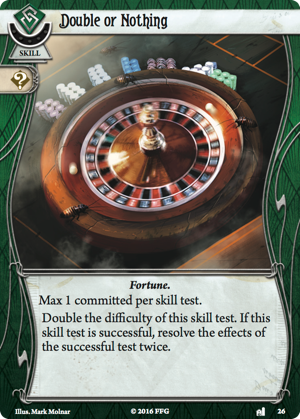
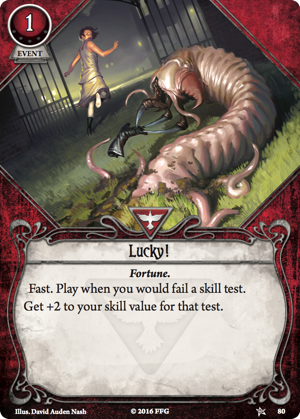
The ugly mathematics
Unfortunately, when dealing with random events, it is hard to escape probabilities. Fortunately, the concept needed to cover a skill test in Arkham are not that advanced.
Let’s start with a player resource trade without randomness involved. In the previous post, we defined the Total Trade Rate (TTR) of a trade as the sum of the resources gained minus the sum of the resources spent.
TTR = sum(Resources Gained)-sum(Resources Spent)
For a skill test, we introduce the Expected Total Trade Rate. In probability theory, this relates to the expected value of a random event.
The expected total trade rate is the sum of the resources gained pondered with the probability of gaining them, minus the resources spent, pondered with the probability of spending them.
ETTR=sum(p_gain*resource_gained)-sum(p_spent*resource_spent).
Illustrative example
Let’s immediately work through an example with one of the simplest tests: taking a basic investigate with Intellect 3 as the first action in the scenario The Gathering. The starting location has Shroud 2.
Since it is a basic investigate, we are spending only an action, with a probability of 1 (the action is always spent). The test, if succeeded, will award us a clue. We are therefore gaining a clue with the probability P_success. The expected total trade rate for this test is:
ETTR=P_success*Cl-1*A
To work out the numeric value of the trade, we need to know the probability P_success. For a 3v2 test with a standard difficulty bag in the beginning of The Gathering, this probability is 0.625 (62.5%). We have therefore:
ETTR=0.625*3.5-1*2.5=-0.31R
Why is the expected total trade rate relevant to the model
Now that we defined and can evaluate the expected total trade rate of a skill test, how can it be used in our Arkham model construction?
- Quantifying Treacheries: a lot of treacheries, such as Rotting Remains have a negative outcome tied to a test. The ETTR can help to compare treacheries.
- Evaluating the workload in a scenario: to get to the resolution of a scenario, investigators have to perform actions with certain outcome (moving is the most common) and do tasks tied to skill test (gather clues from locations of various shroud, fight enemies, parleys, scenario tests, etc). The ETTR can help to estimate the amount of work that need to be done to clear a scenario.
- Shed a new light on in-game decisions: one use of the ETTR is to compare the expected rate of different options when taking a decision in game. I am particularly interested in this topic as it can offer a new perspective on strategic decisions.
Using the expected total trade rate in the decision making process
A skilled player in any game that involve decision making is a player that can select the best of the options available. On the other side, a good game is a game that involve non-trivial decisions: good games makes the best option difficult to identify.
Arkham Horror LCG for sure falls in this category of games, as it forces the players to take lots of decisions between options that have very different outcomes on the game state. Arkham players usually grow in skill by experience (trial and error), and exchanging with the community (which is basically benefiting from the trial and error experience of everyone else). This is a normal and very good way to proceed, and very similar to what is used to improve AIs at playing games that are too complex for brute force solutions.
However, one drawback of this approach is that even if good player can grow to a point where they can “feel” what the best, or at least one of the best decisions is, it is hard to explicit why. The expected total trade rate can be a useful tool in the discussion.
Example use of the expected total trade rate in decision-making
Let’s rewind to the illustrative example of our investigation at 3 Intellect vs 2 Shroud in the first round of The Gathering.
Let’s pretend that we are playing True Solo Rolland Banks, and have in our hand a Working a Hunch, a Machete, a Wolf Mask, and two Guts. Most players would agree that playing the Machete and the Wolf Mask in the first round is a good idea, as it sets up Rolland to confidently face an enemy that might spawn in the next Mythos phase. But what to do with the last action? Our options are:
- Pass
- Draw a card
- Take a resource
- Basic investigate
- Play Working a Hunch and do another action.
Moreover if we decide to investigate, we have the option to commit Working a Hunch for a +2 intellect boost. Before reading further, take a moment to decide how you would rank these options.
Let’s evaluate the ETTR of all the options (see this post for the values):
- ETTR(Pass) = 0-2.5 = -2.5R
- ETTR(Draw) = 1.5-2.5 = -1R
- ETTR(Resource) = 1-2.5 = -1.5R
- ETTR(Basic investigate) = -0.31R (see computation in the section above)
- ETTR(Working a Hunch)= 3.5-2-1.5 = 0R
- ETTR(Basic investigate + commit WaH) = 3.5*0.875-2.5-1.5 = -0.93R
Conclusion on the expected total trade rate
In this post, we extended the resource trading model to game situations where the outcome is random, but with a known probability. While I showed that it can help to assist in taking game decisions, I acknowledge that working through the math of every skill test is something that is both hard to perform and of little utility for experienced players.
I do however believe that understanding that each skill test is a gamble, and being able to evaluate the expected return of this gamble is a critical skill to improve a player success rate in Arkham Horror LCG. Loosing resources to attempt to succeed tests that would be better avoided or failed, or overcommitting to tests of lesser importance are two common mistake in the game.
In the end, the main utility for the expected total trade rate model lies in future extensions of the resource trading model of Arkham Horror LCG. Skill tests and other randomized effects are a critical part of Arkham Horror LCG, and having a way to handle randomness was a necessary step.