Analysis of player resources trading rates in the card pool
In a previous post, we examined which were the main game resources that were controlled by players and traded by card effects to advance the players objectives. We showed that Arkham LCG was about finding good trades toward players objectives, and that a good trades were dependent on two factors: rate and value.
Rate is the absolute balance offered by a card. What resources are spent, what resources are gained. It is a static evaluation.
Value is how useful is performing the trade in the current game state of a scenario. It is extremely dynamic, and the most important when playing. A card with poor rate can be the available card with the best value in the current game state.
In this post, we will examine the rate at which the player resources are exchanged in the current card pool of Arkham LCG, to try to estimate an average trade rate. The value of each trade / individual card is not in the scope of this article.

Resources trading rate model hypotheses
As for any model, the trading rate model is based on several key hypotheses
- Each player resource rate will be given as a number of resource tokens (common unit, symbolized by R)
- On average, level zero cards should offer a balanced total trade rate: the sum of rates of spent player resources should balance the sum of rates of gained player resources
- Only the following player resources are considered in the model (as selected in this post):
- Resources: rate to gain/loose one resource (R).
- Player Cards: rate to draw one card from the top of the deck/spend a card from hand (C).
- Actions: rate to gain/loose an action (A).
- Remaining health/sanity: rate to gain/loose one extra point of remaining health/sanity. This covers soak, self damage/horrors and heals (H).
- Skill modifiers: rate for a one time +1 skill boost/reduction (S).
- Investigator clue pool: rate to gain/loose one clue (Cl).
- Enemies remaining health: rate to inflict one damage to an enemy (D). No cards remove damages from enemies.
Purpose of the trading rate model
The goal of the trading rate model is to examine the average trade rates offered by the card pool. It is to give, for every type of player resources, an average rate in resources (R).
This is model is not useful to evaluate a single card. A card that let a player exchange resources does it at a given rate that the model can quantify. This is the card total trade rate. But the model cannot capture the value of the card. This value depends on the game state, other card synergies, how conditional it is, etc.
So what can this model be used for?
A first purpose is to construct a common unit to analyze different resource trades.
It is also a representation of the inner balance of the card pool. A card that offers an unconditional trade with a total trade rate much higher than the average is likely to be unbalanced and too good.
Its last goal is to explore the effect of XP. I constructed the model under the hypothesis that level 0 cards offer a total trade rate of zero. We expect that cards of higher XP will have a positive total trade rate. How does it increase with each XP point?
Model construction
Resource (R) trade rate
Per construction of the model, gaining one resource has a rate of 1:1.
Card drawn (C) trade rate
Let’s go through the card pool to see at what rates cards and resources are exchanged.
The only cards (that I know of) that directly exchange card and resources are:
- Crack the Case: exchange one card for X resources, X being the shroud value.
- Glory: nets one card for one resource. Conditional to defeating an enemy
- Cheat the System(1): exchange one card for X resources, depending on how many classes you control. Total trade rate: X-C. Not very useful, as it is not a level 0 card and strongly depends on the number of classes controlled.
Burning the Midnight Oil, Sneak By, Clean them out all require to spend a play action, but this action is refunded by granting you an investigate, evade or fight action. They offer a rate of 1:2 (1 card gives two resources).
While cards that offers actionless exchange for resources are rare, many cards have effects that have the player choose between gaining card or gaining resources.
Jack Monterey Ability, Pickpocketing(2), Alchemical Distillation, Patrice’s Violin give the player a choice at a 1:1 rate (one card or one resource).
Jewel of the Aureolus, Chemistry set, Strange Solution : Empowering Elixir, Drawing Thin, offer a choice at a 1:2 rate (one card or two resources).
Overall, we can set the average rate at 1:1.5. 1C = 1.5R
Actions (A) trade rate
Many cards offers to trade between cards, resources and actions:
Gaining actions:
- Swift Reflexes: 1A=1C+2R gives a rate of 1:3.5
- Honed Instinct: 1A=1C+1R gives a rate of 1:2.5
- Shortcut: 1A=1C gives a rate of 1:1.5
- Skids ability: 1A=2R gives a rate of 1:2
Spending actions:
- Emergency cache: 3R=1A+1C gives a rate of 1:1.5
- Bank Job: 6R=2A+1C gives a rate of 1:2.25
- Thorough inquiry: 4C=2A+2R gives a rate of 1:2
- Stand Together: 4R=1A+1C gives a rate of 1:2.5
- Drawing a card : 1C=1A gives a rate of 1:1.5
The rate for an action is somewhere between 1.5 and 3.5. For this model, we chose 1A=2.5R. Any value between 2 and 2.5 is a reasonable assumption. With 2.5, Stand Together and Honed instincts are net 0 trades, Shortcut nets +1R, and Swift Reflexes nets -1R. Poor Skids ability nets +0.5R when you use it. Taking a basic draw nets -1R. Taking a basic resource action nets -1.5R.
Clue (Cl) trade rate
Let’s look at some level 0 cards that discover clues:
- Working an hunch: 1Cl=2R+1C gives a rate of 1:3.5
- Scene of the Crime (two clues): 2Cl=1A+1C+2R gives a rate of 1:3
- Intel report (two clues): 2Cl=1A+1C+4R gives a rate of 1:4
- Task Force: 2A+1Cl=2A+1C+2R gives a rate of 1:3.5
You can also discover a Clue by doing a basic investigation. In that case, you are essentially trading one action for the probability of getting a clue. Most people will take that trade if their skill value is one to two above the shroud, which gives 62.5% or 81.25% chance to get a clue on a standard Night of the Zealot bag. That puts the rate for a clue between 1:3 and 1:4.
With this, we can comfortably set the rate for a clue at 1Cl=3.5R
Heal and Soak (H) trade rate
Both Heal and Soak have the same effect of increasing an investigator remaining health and sanity, but operate a bit differently. Soak has the cost paid upfront and often uses an asset slot, while heal is reactive. For this reason, soak cards generally offer better rates than heal cards.
Let’s consider some level 0 cards that soaks or heal with close to no other effects
- Hunter Armor: 4H=1C+1A+4R gives a rate of 1:2
- Leather Coat, Cherished Keepsake: 2H=1C+1A gives a rate of 1:2
- Obsidian bracelet: 6H=1C+1A+3R gives a rate of 1:1.17
- Tetsuo Mori: 4H= 1A+3R gives a rate pf 1:1.38
- Second Wind: 2H=1A+1R gives a rate of 1:1.75
- Medical student: 4H = 1C+1A+2R gives a rate of 1.5
There is plenty of other examples, but most oscillate between a 1:1.17 and 1:2 rate. A reasonable average for Heal and Soak is a rate of 1H=1.5R
This is also in agreement with the consensus that healing 1 for one action (net trade rate of -1R) is generally of poor value, while healing 2 for one action (net trade rate of +0.5R) is good.
Damage (D)
Dealing damage to enemy can come in two ways: either guaranteed damage, or damage associated to succeeding at a skill test. We use gD and sD to label them.
Let’s consider some zero level cards dealing guaranteed damage:
- Sneak Attack, Explosive Ward: 2gD=1C+1A+2R gives a rate of 1:3
- Small Favor: 2gD=1C+1A+4R gives a rate of 1:4
- Toe to Toe: 2gD=1C+1A+2H gives a rate of 1:3.5
- Monster Slayer: 2sD=1C+1A gives a rate of 1:2
- .32 Colt : 12D = 1sC+ 7A + 3R gives a rate of 1:1.83
- Counterpunch: 1sD=1C gives a rate of 1.5
Overall, testless damage average a rate of around 1:3.5 while damage associated to a fight test around 1:1.75.
This is interesting in a couple ways. First, it means that testing for 1 damage (1.75R) is not worth an action (2.5R), which explains why basic fights are not attractive actions. Moreover, the ratio between the result (a guaranteed damage 3.5R) and the opportunity (a test to deal a damage 1.75) is 2. For clues, the rate for a guaranteed clue was 3.5R, but testing for a clue is worth an action (2.5R), so the ratio is 1.4.
Why such a difference? The difference is that testing for a clue has no downside in case of failure. You just loose the action. While failing a fight action has a much greater impact. The enemy might have retaliate, and failing to kill it this turn might cause you to suffer an extra attack.
Anyway, we can now keep the two rates:
- Guaranteed damage 1gD =3.5R
- Tested damage 1sD =1.75R
Skill boosts (S)
The last resources to rate are skill boosts. What is the rate for a one time +1 skill boost? We can take two methods to estimate a rate: looking at the card pool, or looking at what a skill boost does.
If we look at cards, the consensus is that trading a card for one symbol is a poor rate, while trading a card for two is fair. This is why Unexpected Courage is still playable today. Unexpected Courage is 2S=1C which gives a rate of 0.75:1
This is also the rate at which Streetwise (3) lets you buy skill boosts. Higher Education(3) gives you 0.5:1 and is considered the best resources to skill converter. Most of the others gives a 1:1 rate
If we look at the effect of a skill boost, it is to change the probability of succeeding a skill test. Imagine you are investigating with a base stat of 4 vs a Shroud 3 location. You are essentially trading an action (2.5R) for the hope of getting a clue (3.5R). At 4vs3, your success probability on a standard NoZ bag is 62.5%. This trade has a rate of -2.5+62.5%*3.5=-0.31. Having a +1 boost now gives you 81.25% chances of success for a rate of -2.5+81.25%*3.5=+0.34. The rate on your investigate improved by 0.65.
Both methods gives quite close results, and we keep for our model a rate of 1S=0.75R.
Trading Model summary
We now have a model with an estimate of the exchange rate of each player resource:
- Resource: 1R
- Card: 1.5 R
- Action: 2.5 R
- Clue: 3.5 R
- Point of Heal/Soak: 1.5 R
- Damage(with a test): 1.75 R
- Damage (testless): 3.5 R
- + 1 Skill boost: 0.75 R
Let’s imagine for an instant that a permanent card existed that allowed an investigator to buy/sell any of these resources at these rates. That card would be insanely powerful. Yet, I claimed that these rates are all fair and representative of the average rate in the card pool at level 0. What is the difference? The difference is availability, and that makes a good transition for the difference between rate and value.
At some point in the game state, you might need one specific type of resource. Many cards could have you trade for the resource you need at a rate equal if not better than the one listed above, but:
- You might not have the said card in hand
- You might not have the required resources that are part of the cost to play the cards
A permanent would erase all of these issue, as you could trade any of the resources you don’t need now for the one you need.
A card has value if it can give you what you need. Great value if it does so at a good rate. How to consistently find value is however a topic for another day.
Application of the model to the card pool: events
We constructed the model under the assumption that level 0 cards would offer on average a total trade rate of zero, and expected that XP cards would offer a positive total trade rate.
We can test these hypotheses by evaluating the total trade rate of cards in the pool. The easiest cards to evaluate are events, as they are one time effects that trade resources. I identified close to 200 events that trade between the resources of the model.
For each one, I computed the total trade rate (TTR) as for the examples bellow:
- Emergency cache : TTR=-1A-1C+3R=-1R
- Look what I Found: TTR=-1C-2R+2Cl=3.5R
The results for all the events evaluated is presented in the following graph.
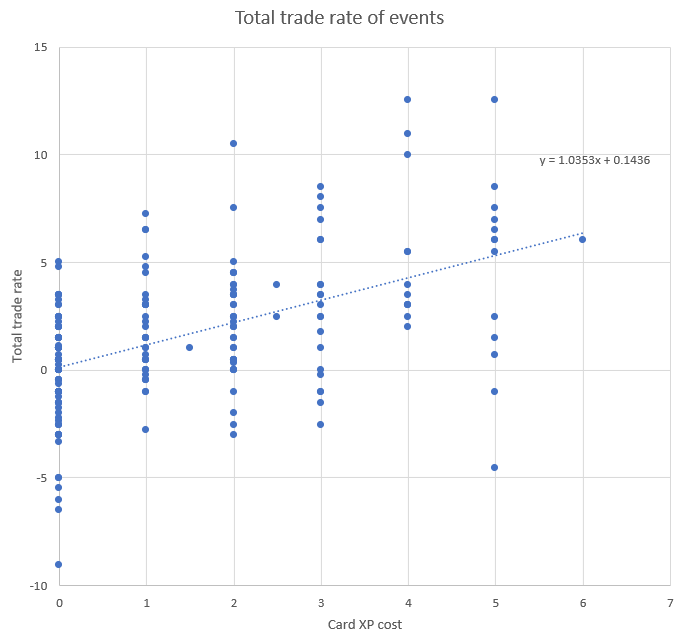
At level 0, the average total trade rate of a card is, as we expected from our hypotheses, close to 0R (0.14R)
The trend for higher XP cards is also positive, with a slope almost equal to 1. That is the first interesting result of this model. The value of one extra XP on an event card is around one extra resource on average.
Afterthoughts on the player resource trading model
I presented in this article an evaluation of the average player resource trading rate offered by the card pool. This model allowed to collapse the complexity of many cards effect to a single number : the total trade rate of the card. This, averaged across the card pool, allowed to highlight the effect of XP and the “bonus rate” you should expect from spending XP.
The complexity of card effect cannot however be resumed by a single number. This is why I want to make clear that the number given here (and in following posts) are not evaluations of the cards. The value of an individual card is dependent on many other factors that are not captured by this model:
- Availability: can your investigator play the card?
- Opportunity cost: decks have limited number of cards and some asset can also compete for one of your slots.
- Synergies: cards interacts together, with cumulating effects, combos, traits interactions, etc.
- Consistency: some cards have play conditions that make them less easy to get value of.
- Purpose: each card usually has a main purpose (enemy management, clue finding, encounter protection, resource generation, card draw, etc). The value of a card in a deck depends on the deck ability to perform each role without it.
- Game state: this is maybe the most important. The value of a card effect depends on the current game state. An evasion card is worthless with no enemy. Big assets looses value when the scenario is about to end. The value of your last point of health / sanity is way bigger than the first one you loose.
In following posts, I will expand this model by looking at other parts of the card pool (limited uses assets, skills, treacheries & weaknesses). Before we delve further…