Lone Wolf: Dexter Drake, The Magician
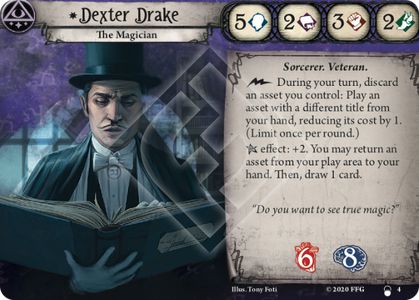
Coming from the Innsmouth Conspiracy investigator expansion, Dexter Drake is printed with a 5W 2I 3F 2A statline and a 6/8 health/sanity split.
Elder sign: +2. You may return an asset from your play area to your hand. Then, draw 1 card.
This elders signs at least does something. However, it is kind of the reverse of Dexter‘s ability, which is strange. Usually, you want your depleted assets to be fodder to trigger your ability into playing fresh ones action free and at a discount. The only useful case I see is if you have no suitable replacement for a depleted asset, in which case the refill and card draw are useful. Very niche though.
Ability: Once per round, can discard a controlled asset to play a different one, action-free and with a 1 resource discount.
On paper, this ability seems quite strong. It indeed saves one action and one resource each time you use it (3.5R in my model). However, I do feel that, even with the full current card pool, building too much around Dexter‘s ability is still a bit of trap. It is possible to build very fun and good builds around it (I have one example of such deck bellow), but it is probably not the strongest way to build Dexter.
The idea of binging through assets is nice, but quickly runs into a lot of issues. Mystics spell assets are expensive enough that burning them with charges remaining isn’t worth it. They will also last longer in Solo, as a single Shriveling could be half a scenario worth of fighting. The same goes for doomed assets, such as Dowsing Rod. Even though you could in theory pile up doom and swap them when it would cause the agenda to advance, the resource cost is barely worth the tempo gain. You could think of going the opposite direction, playing fast and cheap assets (such as switchblade) to transform them into useful ones, but at this point you are paying a card and deck slots just to save on one action. Quick-thinking does about the same.
I often find myself not using the ability more than 3-4 times in a scenario. However, I do believe that it is still a decent ability to have. The best use for it is to delay paying for your fight spells. You can instead use value assets (Scroll of Secrets and Scroll of Prophecies) first, and turn them into spells when depleted. Scroll of Secrets (the tabooed version) is already a very good mystic card at level 0, it becomes outright fantastic in Dexter, being effectively a 0 cost, fast, draw 3 cards with a chance of discarding weaknesses. The other perk of Dexter‘s ability is fight management. Because you can just swap your empty assets for a new one while engaged with an enemy, you never have to fear running out of charges/ammo as long as you have another useful asset in your hand.
Deckbuilding: Mystic 0-5 / Rogue 0-2
Let’s just say it first: this deckbuilding offers the most abusive XP acceleration an investigator can pile up. With 2xArcane Research, Down the Rabbit Hole and Charon’s Obol, you can add 6XP of upgrade on top of what each scenario gives you. You can resign most of the scenarios and still end up on par with some investigators that full clear them.
Aside from this, for an investigator with 5 willpower, full Mystic access is never bad. The interesting decisions come when looking at what to do with the Rogue splash. Dexter‘s low agility means that a lot of the Rogue pool will be left aside. However, Rogue has a lot of economy support when the Mystic class struggle with it. It also has a lot of payoffs for evading, which means Dexter can use the Mystic evade spells a lot of other investigators have no room for. Finally, even though Seeker is better than Rogue for it, the class still offer some curse interactions should you want to build in that direction.
Signature Kit
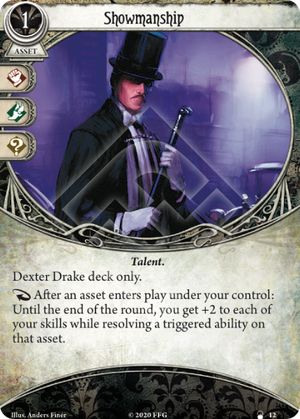
Showmanship is hardly the best signature asset. It is at least cheap enough to be played free using Dexter‘s ability.
Its effect is however underwhelming. In True Solo, it is not that common to perform two actions on the same asset in a single round (fighting large enemies might be the one exception). I’d say its effect is hardly better than the one of the Masks, which are good level 0 cards, but I expect more of an investigator signature.
The main use I can see is if you include Flashlight in your clue getting plan. With the effect of Showmanship active the turn they come into play, you are getting an effective +4 to investigate, which gives Dexter a fair shot at shroud 3/4 locations.
Another option is to use it as a third Cat Mask should you want to play with a weapon based Dexter. I believe that with just Showmanship, this build is a trap, but adding Cat Mask brings just enough consistency for Dexter‘s 3 fight to be workable.
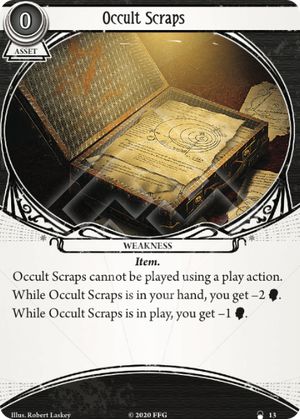
Occult Scraps is just as mild as Showmanship. Minus two Willpower fairly is annoying, but can be worked around, especially with an high XP deck.
What makes it mild is how easy it is to discard, provided that you have an asset you were willing to discard anyway. All it does then is delaying by one round its replacement with a usable asset, and giving you minus one willpower during that round.
While it is a nice design for a weakness as it is closely tied to Dexter‘s ability, it is definitely on the softer side.
Preformance review for True Solo tasks
Clue Gathering
Base 2 intellect is not worth building upon. With Dexter, we will be using our Willpower to get clues.
Fortunately, there are plenty of assets and events to do so in the modern card pool. As Dexter, you are encouraged to play assets with different titles, which means that mixing it up a bit with the likes of Divination, Dowsing Rod, Close the Circle is encouraged.
One big part of the mystic game is arcane slots management. Fortunately, with his ability, Dexter can make a very good use of his hands slots to alleviate some of the pressure on arcane slots. Heck, even a simple Flashlight becomes quite good when its effectively 1 Cost and fast.
Overall, Dexter has no trouble investigating whatsoever, without being overly impressive at doing so.
Enemy Management
When it comes to enemy management, a 5 willpower mystic will never disapoint. Yes, it does often imply playing a spell asset of some sort, but even Gardians need to play a weapon.
Dexter has access to Shrivelling, Azure Flame, Brand of Chtugha. Its Rogue splash can generate enough curse for Armageddon to be workable too.
He has 3 fight, which, while not being as consistent as playing the spells above, opens up some alternative builds using a fight based weapon in the hands.
Having access to Dirty Fighting, Dexter is also one of the few mystics that can make evade spells shine.
Finally, his ability enables swapping a depleted weapon/spell in the middle of combat, or playing one while engaged. It is convenient as it means Dexter doesn’t have to pay the upfront costs of the fights assets until they are needed.
Mythos Defense - Survivability
With 5 willpower, Dexter enjoys the mystic edge of being resilient to the most tested stat on treacheries.
Its agility is on the weaker side, though, with only 2. Combined with only 6 health, this makes him vulnerable in the campaigns that test agility the most (notably Forgotten Age). However, the mystic class provides plenty of encounter protection (Ward of Protection, Deny Existence, Promise of Power) that can soften this weakness.
Dexter can also use soak assets to take a few damages before cycling them. The two most notable ones are David Renfield, that you want to leech for resources before killing/swapping him, and Leather Jacket, that is fast and can take a damage before being swapped for something more active.
The last point to mention is that if you are playing the greediest XP version of Dexter, you will start with 4 traumas. Something to be aware of, but very manageable.
Action efficiency - Economy
I already stated that Dexter‘s ability has a strong effect, but will not be activated enough for it to compete with top tiers ability out there.
He does enjoy the support of the Rogue class access, which provides a strong resource generation to fund his stream of assets.
The Rogue class also gives access to interesting cards for his action economy (Eon’s Chart(1) being one of the most notable one). Dexter is also one of the best users of Close the Circle, with his high willpower, the ability to start with a Rogue permanent, and the extra value he gets upon discarding it.
Thanks to his ability, he also has access to card draw through the Scroll of Secrets and Scroll of Prophecies.
Overall, he has a solid economy, that can keep up with the pace of the game, without breaking it.
Deckbuilding ideas
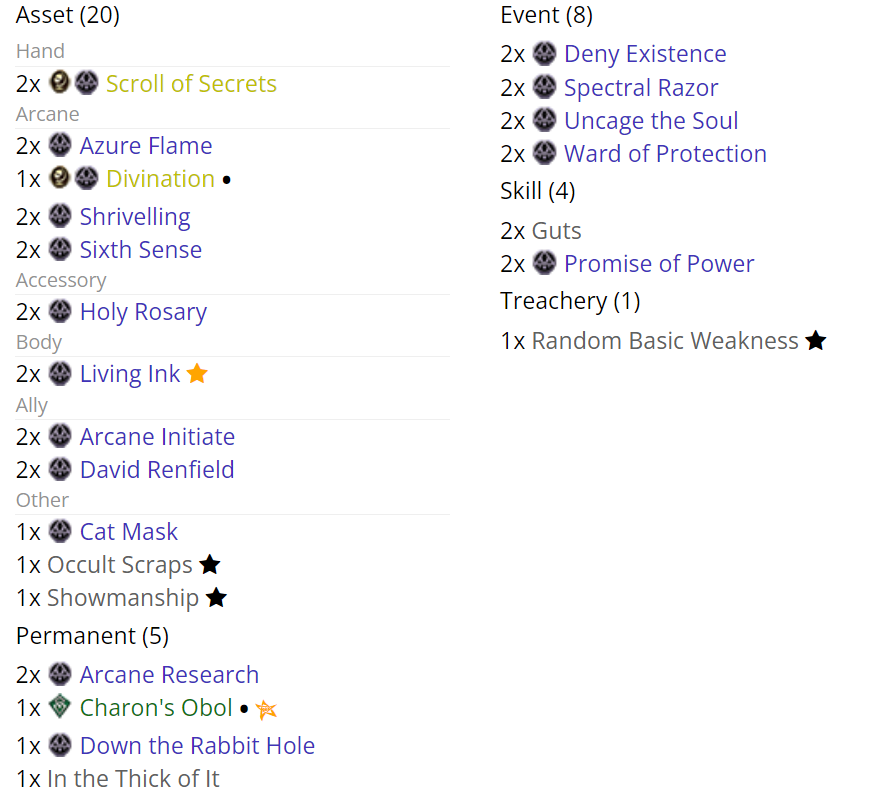
The most boring magician

This deck is maybe one of the most boring ways of building Dexter. The only Rogue card used is Charon’s Obol.
On the flip side, this deck is extremely consistent and will upgrade insanely fast. Each of the pieces have a clear purpose, which makes choosing the upgrades very simple.
The deck is built around spell assets for both fighting and investigating with willpower (4 and 3 respectively). To boost the willpower to consistent values, the deck features Holy Rosary, Cat Mask, Guts and Living Ink. For passing non willpower tests, it is supplemented by Promise of Power. A solid Mythos defense is built in with Deny Existence and Ward of Protection.
The deck supports its card draw with Scroll of Secrets (one of the best target to be pitched by Dexter‘s ability), and Arcane Initiate (that can either be killed for soak, or swapped right before the agenda advances for another asset). With 13 out of 33 cards being spells, the Initiate will get you a lot of cards.
The resource generation is provided by David Renfield & Uncage the Soul. Just as for the Initiate, David can be safely played thanks to Dexter‘s ability.
The final touch of the deck is the 2xSpectral Razor, though this is more of a wildcard slot, that can be swapped for other spells such as Read the Signs, depending on the campaign characteristics.
I will not even bother presenting a 29XP version of this deck, first because with this deck, I got to 31XP after the first three scenarios of Dunwitch, and because the upgraded deck just uses upgraded versions of the level 0 cards. Just make sure you upgrade one spell each scenario, and choose the upgrades based on the needs of the next scenario.
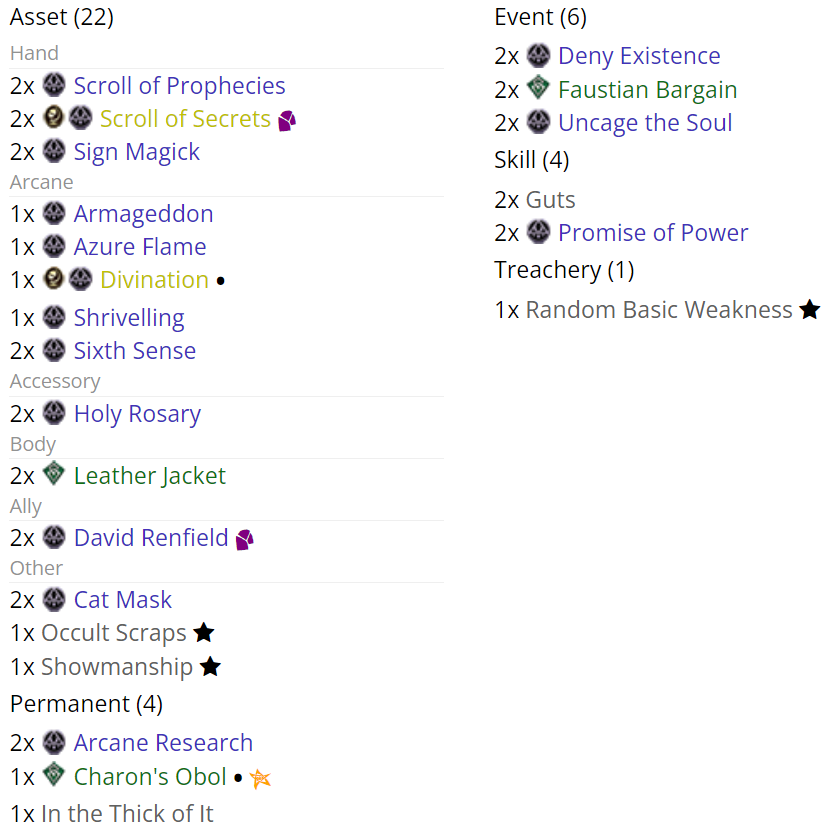
The Rainbow Magician

At level 0, this deck has a lot of similarities with the previous one. The main difference is that it is a bit less spell heavy, which is why the Arcane Initiate has been replaced by Scroll of Prophecies to boost the card draw. The deck also drops Down the Rabbit Hole, as it will upgrade to a sensitively different deck. Charon’s Obol remains, as it is both great xp acceleration and a Rogue permanent.
Upgraded deck
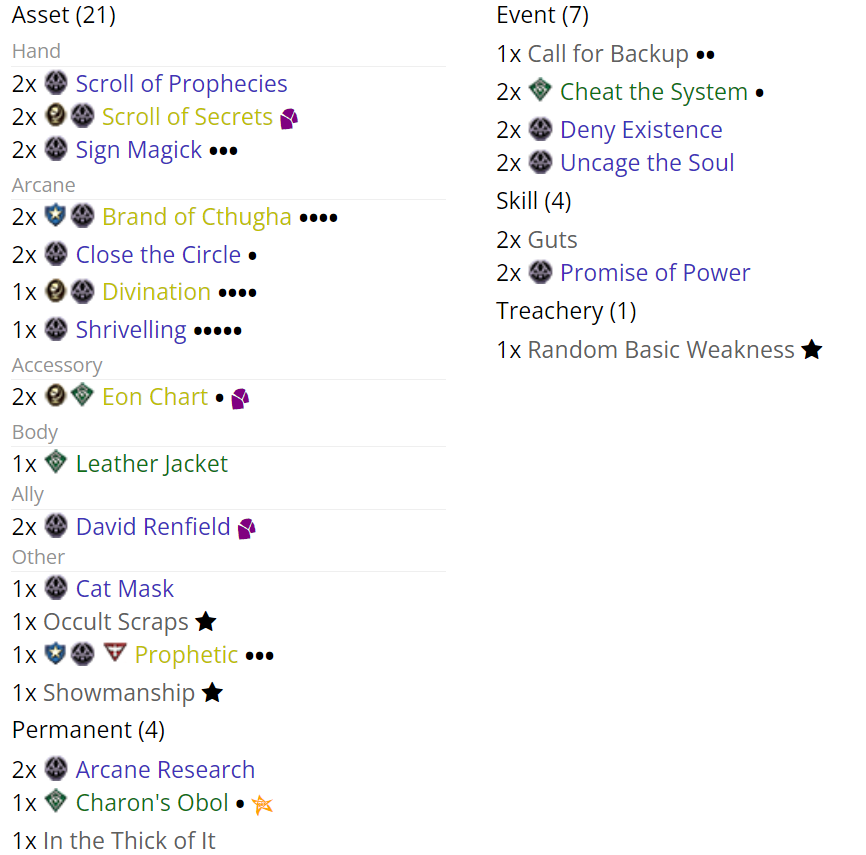
Cursed with many arms

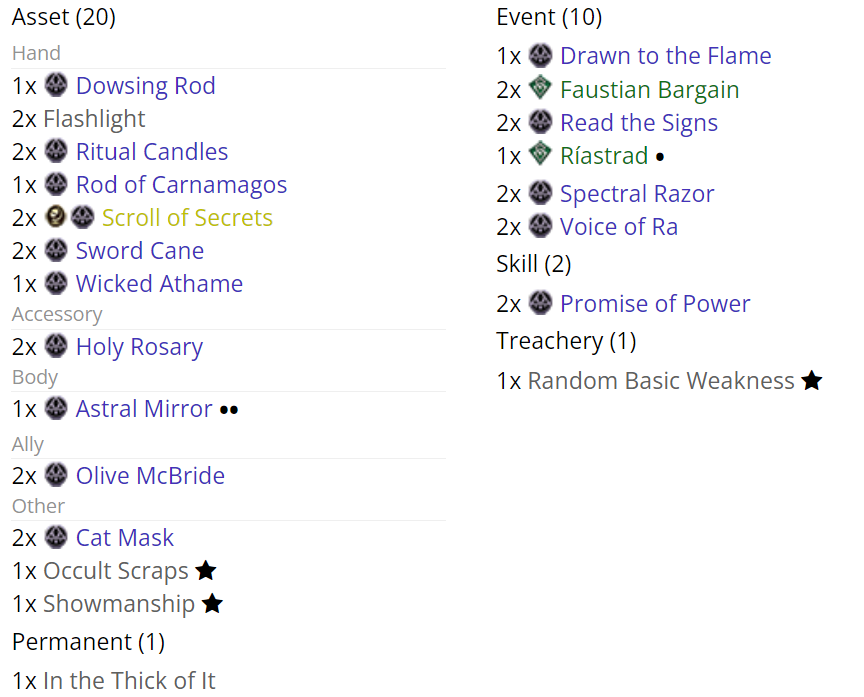
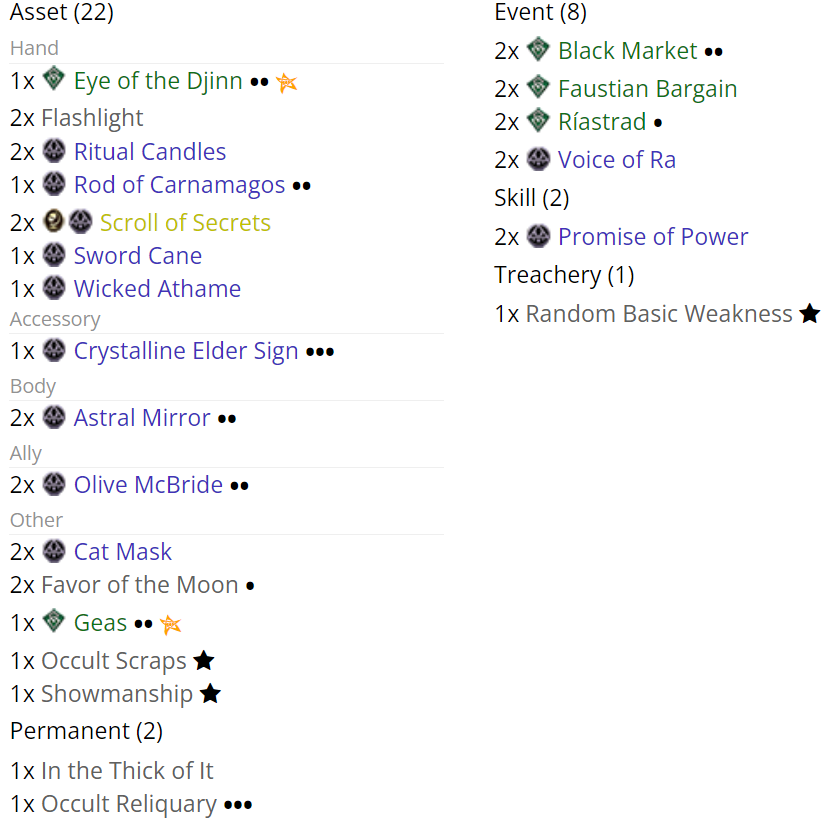
This deck is built around two objectives: messing around with curses, and playing a unique mystic gamestyle where the arcane slots are not used. The star of the deck is Astral Mirror, that both gives Dexter four hand slots, and enables him to cycle through hand assets at warp speed (being effectively able to fast out two hand asset per round with Astral Mirror and his ability).
At level 0, with only one Astral Mirror in the deck, hand slot management might be tight. This is why the deck features events such as Drawn to the Flame, Read the Signs, Riastrad and Spectral Razor, which can help advancing the game even if you currently do not have a hand available for the right tool.
To investigate, the main tools for Dexter are Flashlight, and Dowsing Rod. Enemy management can be done with the help of Sword Cane, Wicked Athame and occasionally the Rod of Carnamagos. The deck obviously misses a 2+ damage asset, which means that chunky enemies will evaded with the cane or handled through events.
At level 0, the curse interaction is still limited, though the deck features Faustian Bargain, Promise of Power and Wicked Athame that all put curse in the bag, and the Rod of Carnamagos as a payoff.
Olive Mc Bride is there as a cheap soak, (and to be upgraded should you want to run Down the Rabbit Hole), but could be substituted for David Renfield.
Finally, the deck has a solid resource generation potential with both Faustian Bargain and Voice of Ra, which is needed to fund events and the stream of hand asset you want to be playing.
Upgraded deck
My evaluation of Dexter True Solo power level
Dexter Drake is an interesting investigators. Amongst the 5 willpower mystics, his statline and ability are not really the best. A comparison with, for example, Agnes Baker makes it obvious that Agnes as an easier set-up and built-in engine.
Dexter Drake requires a bit more finesse to operate at his full potential, as you have to carefully chose in which order to play your assets. He however is very rewarding to play when you can line up the pieces correctly. He also helps to solve a usual issue of Mystics in True Solo, which is to miss arcane slots to do everything you want to do, as he has a valuable use of is hand slots.
From his in scenario raw efficiency alone, Dexter would be A solid A tier investigator. However, he enjoys one of the best XP scaling of the game, which means he will be consistently very strong in the later scenarios of a campaign. My overall True Solo ranking for Dexter is: