Introduction
In the “5 cool cards to…” posts series, I look at the card pool for the most interesting cards to assist in rounding up a deck that might struggle with some of the challenges required to perform well in true solo.
To keep the posts to a reasonable size, I select cards with the following rules:
- 5 cards maximum per class
- Level 0-2 cards (to maximize the investigators that can access them, and facilitate the use in starting decks)
- Variety of archetypes (to avoid shoehorning players into one deck type)
- Suited for true solo (some cards have amazing value in 2+ players, but are less interesting playing solo).
How to defeat enemies with low fight
Managing enemies is one of the most important tasks in Arkham horror LCG. There are many different ways to deal with them, all of which have their uses.
Enemies can be defeated, evaded, avoided, incapacitated, or even reshuffled in the encounter deck. In this section, we will look exclusively at ways to defeat enemies. There are multiple reasons that makes having ways to defeat enemies important. Some scenarios have a boss you must defeat to reach the resolution. Some enemies have victory points on them. And some are fairly easy to kill but very annoying if left on the board (I’m looking at you cultists).
For this reason, in this post, we will look at cards that enable defeat enemies for investigators with a low fight stat.
Neutral cards
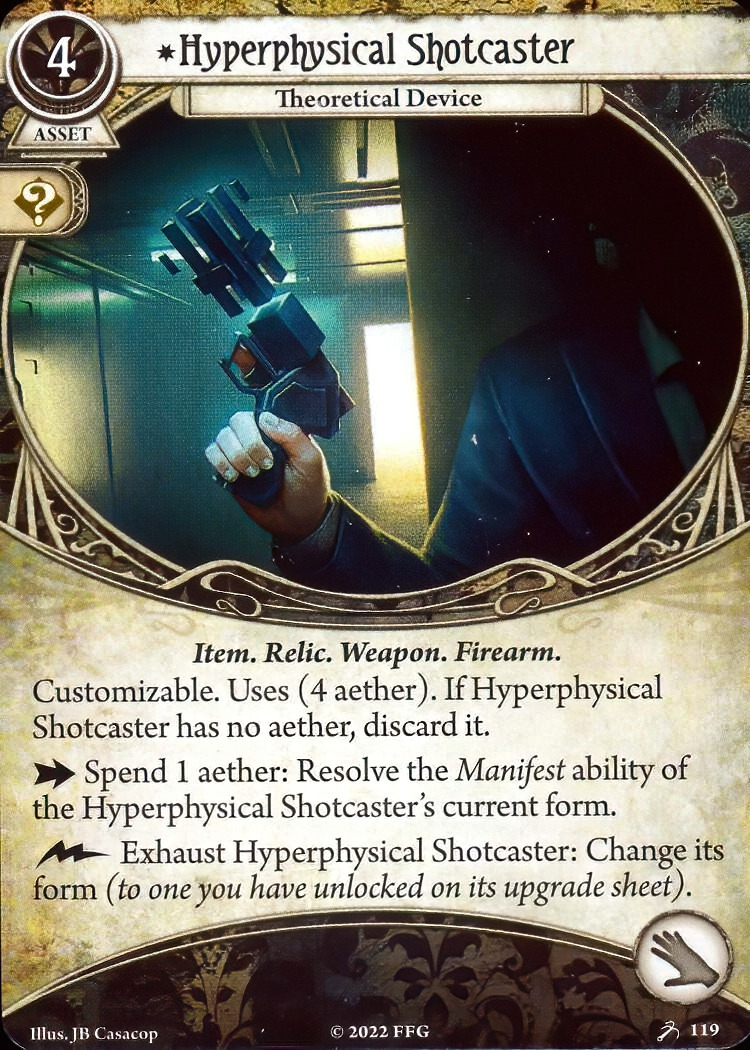
Hyperphysical Shotcaster / Archetype: Use another stat
Here it is again. Hyperphysical Shotcaster, with the Railshooter upgrade, allows to fight with your highest stat (most likely intellect or agility, as high willpower investigators are usually mystics and their spells are just better). Unlike Telescanner, though, the upgrade just give a +1 damage and does not open up any cool playstyles.
It is most suited for investigators that have a native 5 in one of the stats, and intend to use it as much as possible. The main drawbacks are the resource and XP costs, the slot, and the fact that refilling it is impossible without discard recursion.
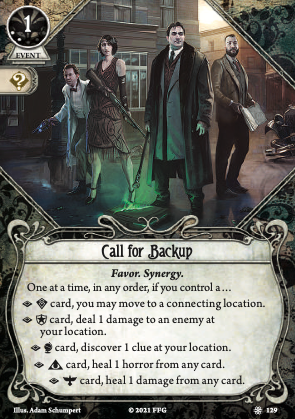
Call for Backup / Archetype: Synergy
For this card to deal damage, you need to control at least a guardian card.
Testless damages are always great, but this card will trigger an attack of opportunity from enemies engaged to you. To be playable in Solo, this card is best used combined with a move. Moving once and removing a cultist for 1 card and 1 resource is great.
To really justify the XP cost, though, it is probably only worth including if you have a decent chance at triggering a third effect (the clue being the most valuable one). But it is easy enough to achieve for a good number of investigators, and with multi-class cards.
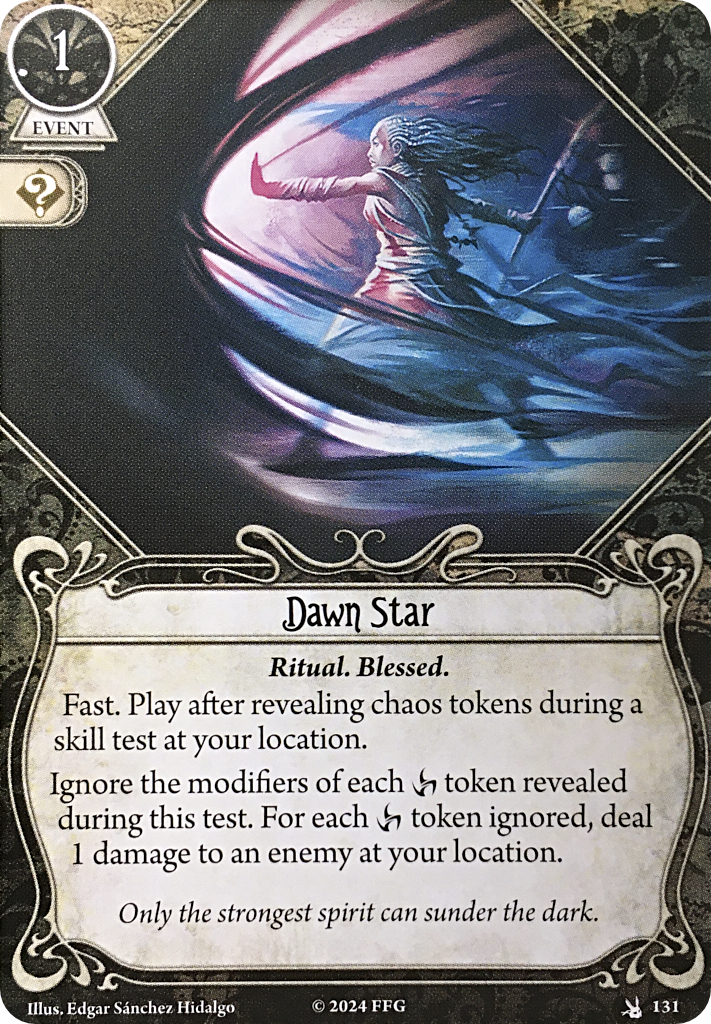
Dawn Star / Archetype: Curse
This card is very powerful, in a build that supports it. If the bag is loaded with curses, it will at least be useful (saving a test you would have failed, and pinging an enemy if there is one at the location).
But to be worth including in a true Solo deck, the deck should be able to reliably reveal curses on demand. Cards such as Kohaku‘s signature, Favor of the Moon, Rod of Carnamagos, Olive Mc Bride are all excellent ways to increase the damage dealt.
This card also fixes the issue of cursed spells such as Armageddon, where you want to draw a lot of curses, yet still pass the test. Armageddon(4) + Dawn star with a lot of token drawn is a good way to nuke a boss or clear multiple enemies in the same location.
Guardian Cards
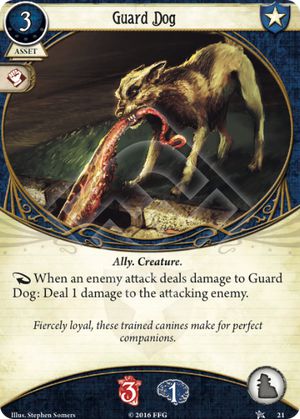
Guard Dog / Archetype: Healing matters – Meat army – Riposte
Guard dog should need no introduction. It work wonders, both soaking and dealing damage for you.
However, Guard dog does have some limitations. To be used optimally, the damages need to be assigned to guard dog one at a time. It means that the horrors and extra damage dealt by enemies must go elsewhere. Guard dog is not a safe plan for a boss fight. It helps, but cannot do enough burst damage.
Guard Dog is at is best hunting cultists. Just move in the location as your last action and let it do the work.
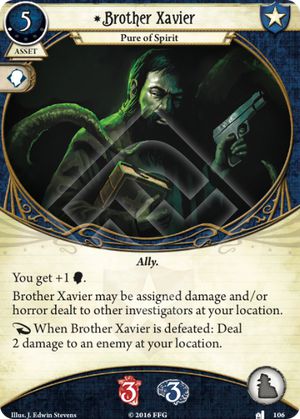
Brother Xavier / Archetype: Meat army – Willpower matters
Brother Xavier is an odd fellow. To be worth the ally slot and the hefty cost, the investigator must have some active use of its willpower, and a solid economy (Diana Stanley comes to my mind).
In opposition to Guard Dog, Brother Xavier offers a permanent stat boost and deals the damage when defeated. He is at is best helping you through the scenario and sacrificing itself on the final boss.
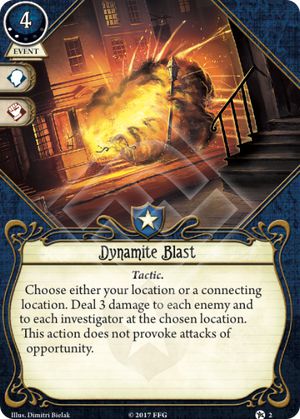
Dynamite Blast (2) / Archetype: Pay to win
Few cards can have as much effect on the board state as Dynamite Blast. I selected the level 2 version because Dynamite Blast is usually worth playing to remove multiple enemies at once. In True Solo, if the enemies at are your location, you are likely to take multiple attacks of opportunity on top of the 3 damage from the blast if you use the level 0 version, which is hard to justify. Ignoring attacks of opportunity makes it more viable to blast yourself.
The card is best used to clear a connecting location, and works great to remove chunky aloof enemies.
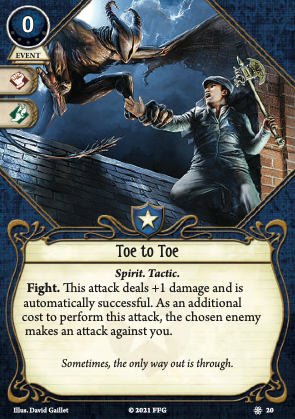
Toe to Toe / Archetype: Riposte
Toe to Toe is a guaranteed 2 damages dealt, at the cost of an enemy attack.
Most of my True Solo losses come from autofailing an/a couple important fight tests. Not only Toe to Toe doesn’t care about your stat, it removes any variance and it helps to secure other effects that trigger on a success to the test (in that case, you succeed by your modified card value).
Toe to Toe can also back-up assets that consume uses to fight, and provide a safety net for a boss fight. The only requisite is to have enough soak remaining.
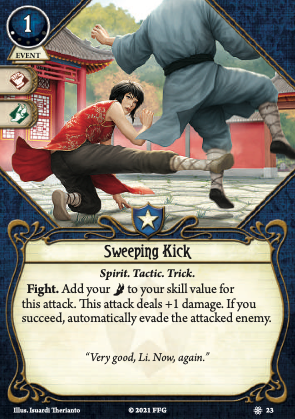
Sweeping Kick / Archetype: Agility matters
This cards packs so much for very little. It is playable by any investigators with a high agility (most investigators will have 6+ combined agility + fight value).
With just the +1 damage, it would still be playable, but not amazing. The automatic evade upon success is however insane, and works even on elite enemies.
It is funny that Guardians, who usually have a high base fight, have so many options to not use it.
Guardians can deal damage by expending allies, getting hit, an through the use of powerful events. Some cards are designed for off-class guardians, and offer to use another stat to do the fighting.
Honorable mentions: Katana – Brand of Cthugha – Beat Cop (2) – Blood Eclipse – Radiant Smite – Strong Armed – Gang up.
Seeker Cards
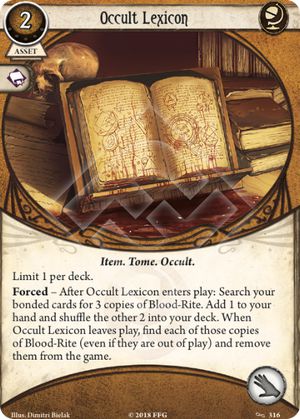
Occult Lexicon / Archetype: Pay to Win
Blood-Rites, of which you get one in the hand and two in the deck, are amazing cards. The standard use of them will be to draw 2 – discard 2, and pay 2 to deal 2 damage to an enemy.
Paying 2 resource, a card and an action to guarantee two damage is good, but not amazing. Where Blood-Rite shines is at it allows on top of it to dig through the deck while discarding your least useful cards (duplicate of assets, for example).
The main drawback of the Occult Lexicon is that it is only 1 per deck. With the Item and Tome traits though, it is not that hard to find.
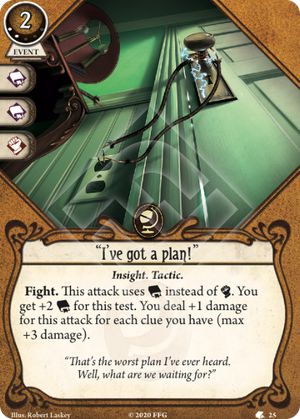
“I’ve got a plan”(2) / Archetype: Intellect matters
Events that can deal up to 4 damage are rare. The ceiling on this card is quite high.
I favored the level 2 version because the level 0 is quite expensive, and the lack of a skill boost can be problematic early on for such a high impact event.
In True Solo, this card can sometimes be hard to use, as some scenarios don’t allow to have a large stockpile of clues when an enemy shows up.
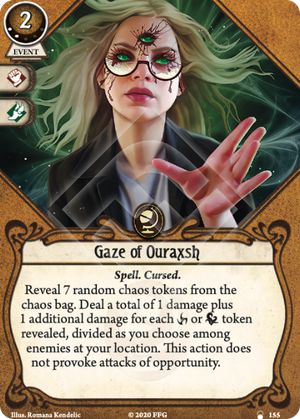
Gaze of Ouraxsh / Archetype: Curse
This card scales with how much of the chaos bag is made of curse tokens.
For a full cursed chaos bag in a starting chaos bag, damage triggers on 11/26 tokens, for an average of 4 damage. It’s of course a lot of work to get there. On the plus side, it takes only 6 curses to average 3, and 3 curses to average 2. Later in a campaign, tough, the inflation of the bag with other symbol tokens make it fade a little.
To boost the damage, the investigators can use effects such as Olive Mc Bride or Favor of the Moon.
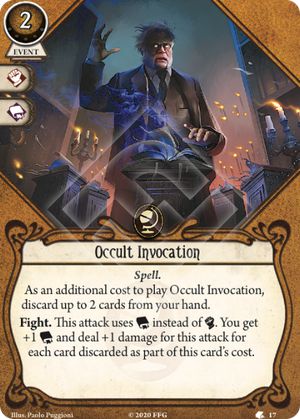
Occult Invocation / Archetype: Intellect matters
3 cards, an action and 2 resources to deal 3 damage with a +2 intellect boost. This rate is not great, and this card would be quite bad if Seekers were not so good at drawing cards.
There is not that many ways for Seekers to deal damage at level 0, though, so this card often makes the cut in some decks that lack other options.
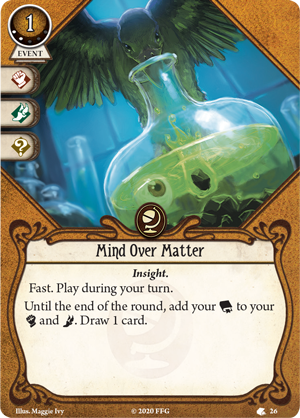
Mind over Matter / Archetype: Intellect matters
Let’s be honest, this card will not help main Seekers to deal with enemies without access to some kind of weapon. Dealing damage 1 by one is not a viable plan in this game.
If you do have access to a weapon that deal extra damage, this card is fantastic. I’d go as far as saying that it is better than Overpower (2) and Manual Dexterity (2) for a lot of investigators. It does cost a resource, but the stat boost is for the whole round, which is great for a boss fight, it is versatile, and the card draw is not dependent on succeeding the test.
It does not apply for the Mythos Phase, but should you need it, it will still give 1 Willpower or 2 Agility icons.
Seekers have a tough time for good killing solutions at low level. Most of their great enemy killing tools are high XP cards. Until there, their strategy is to pay expensive events that either deal testless damage or use their high intellect to hit.
Honorable mentions: Disc of Itzamna, but it cannot deal with elite enemies.
Rogue Cards
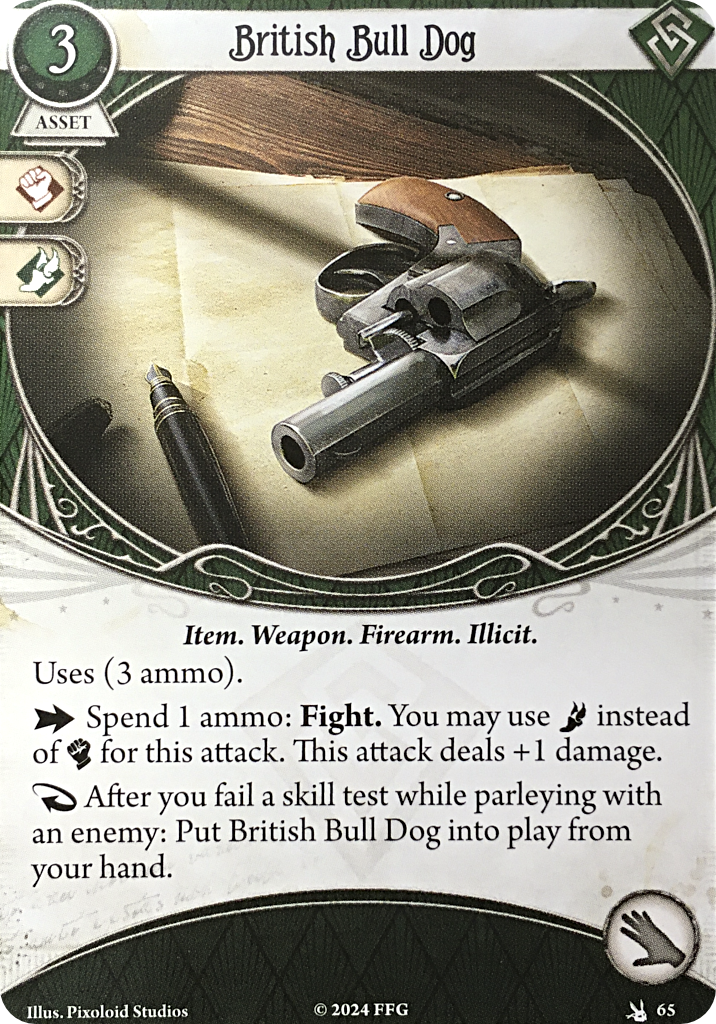
British Bull Dog / Archetype: Agility matters
Finally, Rogues get an asset to fight with agility.
The rate is not amazing, with only 3 ammo and no skill boost, but the class is drowning in agility icons begging to be used on their skill and events. This card enables new plays, such as moving during a fight with Nimble
It is still not perfect, though, because at level 0, Rogues are lacking a +1 agility ally, and it is easy to miss a couple shots using this weapon. Be sure to have back-up or reload options available.
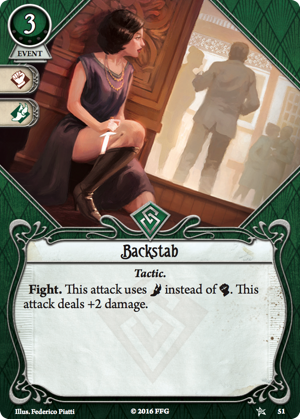
Backstab / Archetype: Agility matters – Chuck Fergus
This was the original way for Rogues to kill things with agility. At 3 resources and with no skill boost, it is often a big gamble to play it.
In the modern card pool, it is however easier to support Rogues with enough agility icons to make it more reliable. As a Tactic, it fit’s quite well in Chuck Fergus events decks.
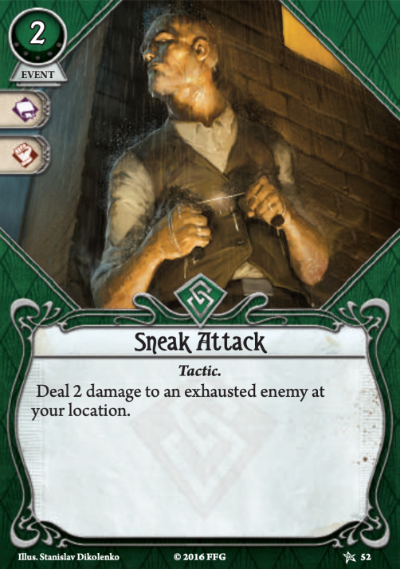
Sneak Attack / Archetype: Evade matters
Sneak attack is Backstab for the risk averse. It does require you to evade first, and does less damage, but the damage is guaranteed.
Because it feels like a waste to evade and play a card to kill a 2 health enemy, Sneak Attack is best used on enemies that you are not confident killing in one round, and in this case it’s a nice payoff for a successful evade.
Just as Backstab, it is a Tactic and works well with Chuck Fergus.
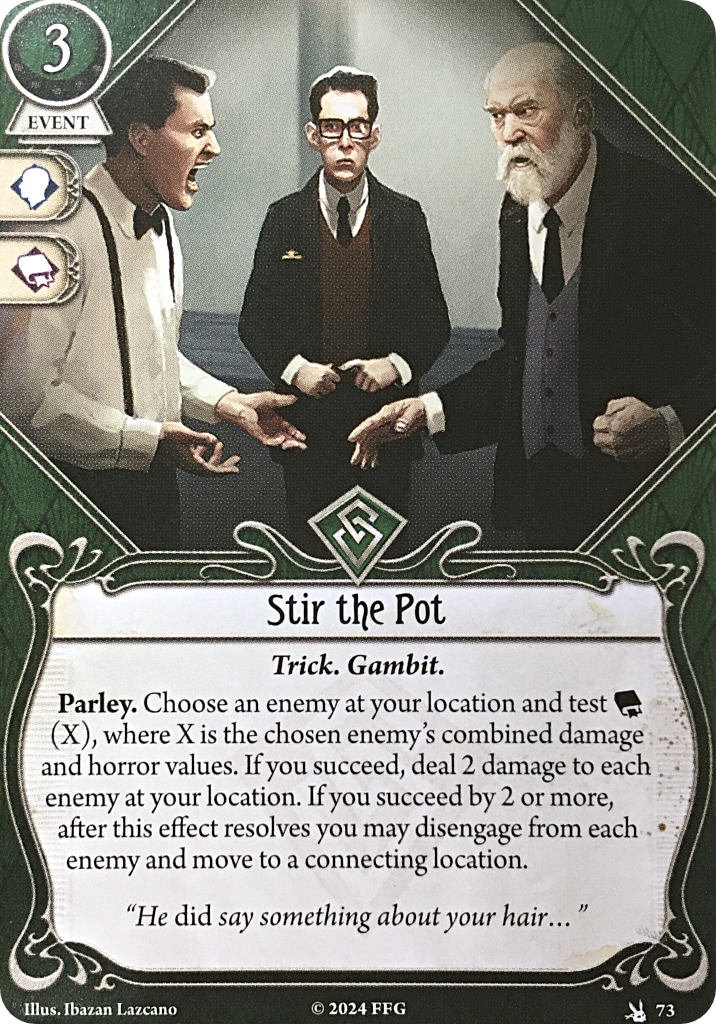
Stir the Pot / Archetype: Parley – Intellect matters – Trick
There is a lot to love about this card. You do have to test Intellect, but you get to choose the weakest enemy for it, so it will often be difficulty 1 or 2. Just as Dynamite, it is AoE damage and bypasses aloof. Unlike it, it doesn’t trigger attacks of opportunity and you cannot damage yourself.
Being able to disengage from all enemies and move is a cherry on top that can be a life saver in dire situations.
In early campaigns, the first scenarios often feature parleys to perform, and the duo Fine Clothes / Stir the Pot does wonders there.
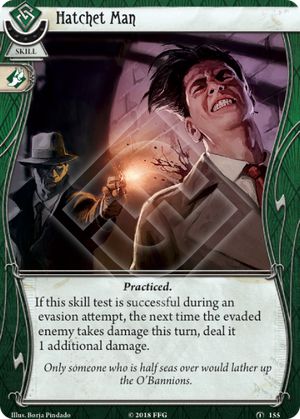
Hatchet Man / Archetype: Evade matters
This card has quite a narrow use, yet can be useful to up the damage output of investigators that favor evading enemies before killing them.
It’s not great on its own, but combine nicely with cards such as Pickpocketing / Dirty Fighting to increase the value of the evasion.
Rogues have several ways to proceed when trying to kill enemies without using their fight. They can attempt to use their high agility to outright kill them, but they tend to suffer from having only limited and expensive options to do so. They can take a slower route, evading the enemy and grinding it down in a couple more actions. Their last option is to spend resources on high cost solutions with guaranteed effects.
Honorable mentions: Cheap Shot, Small Favor, Coup de Grace, False Surrender
Mystic Cards
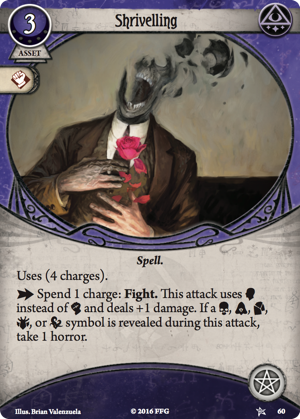
Shrivelling / Archetype: Will matters
Shrivelling (but also Azure Flame, and Armaggedon) are part of the core of the Mystic identity. All are spells assets that let the investigator fight using willpower, and do extra damage. They have just enough differences to make some better than other in certain decks, but not so much that discussing them separately is worth it.
Shrivelling is better for investigators that have low health, Azure flame for investigators with low sanity or are looking to draw symbol tokens, and Armaggedon in cursed decks.
Most interactions are well known by the community. Upgrade them with Arcane research /DTRH, pay them with Uncage the Soul , search them with Arcane Initiate, recharge them, etc.
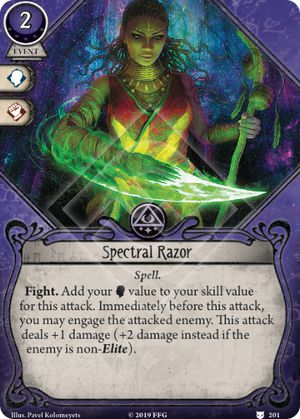
Spectral Razor / Archetype: Will matters
Another staple in the Will matters archetype. The interesting discussion is why it is interesting to play it on top of the assets listed above. It cost almost as many resources and is single use. Looking at the raw damage, we are paying 2 for 3 damage while Shrivelling is 3 for 8 damage, a better rate.
Three factors makes up for this difference.
First, assets needs to be set up before the fight happens. This makes Spectral Razor a great panic button should you find your other fight assets depleted mid fight.
The second factor is that it adds the willpower to the fight skill instead of testing it. While it fades once the assets spells are upgraded, at level 0, it makes it much more reliable to hit every enemies. An interesting side effect (for Sister Mary and Diana Stanley) is that you can also commit Vicious Blows to it.
Finally, you also get to engage the enemy, which is great to hunt aloof enemies or protect a teammate.
It does lose a damage fighting elites. Still an incredible card.
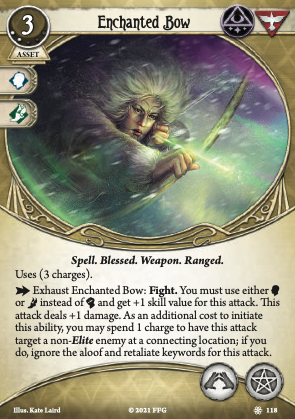
Enchanted Bow/ Archetype: Will matters – Agility matters – Ranged assault
The immediate thing one must notice is that a weapon that takes three valuable slots and exhaust upon use requires a plan to work out. The big payoff though, is that you can hit non elite-enemies from a distance 3 times, and more if you can recharge it. It also have unlimited uses at your location.
To succeed with it, though, you need to have ways to either ready the bow (such as Luke Robison with The Raven Quill), or enough additional damages to take down the larger enemies.
In the Hemlock Vale investigator expansion were introduced Long Shot and Strong Armed, two excellent skills to up the bow damage (though the second one requires to fight with agility). Silas Marsh, Ashcan Pete and Agnes Baker can all build great bow hunter decks.
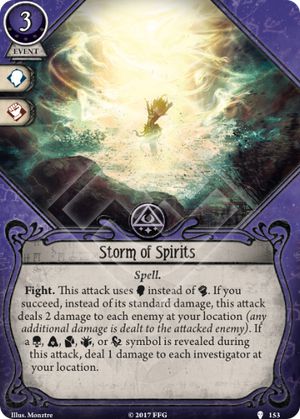
Storm of Spirits / Archetype: Willpower matters – Tech
This is Mystic’s mini Dynamite Blast. This card does require a test, but most of the time, you get to choose the enemy at your location with the lowest fight value. In Solo, the eventual self-damage taken is not that meaningful.
Whether or not this card makes it into the deck is very campaign dependent. In Solo, having multiple enemies at the same location is not that common. However, when it does happen, it usually create high stress points that cards such as this one can help to cope with.
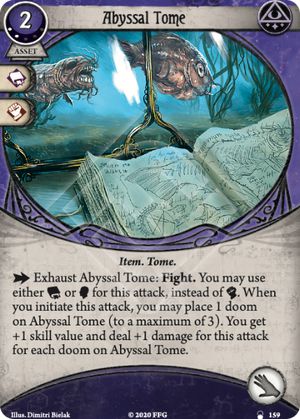
Abyssal Tome / Archetype: Doom – Willpower matters – Intellect matters
I kept one of my favorites for the last. To my knowledge, Abyssal Tome is the only asset without uses that let you fight with intellect. You can in fact use three of the four stats to fight which can be interesting for some investigators and when using skills.
Abyssal Tome has two problems: it exhausts, and you have to manage the doom.
At its low point, it is a Wither in a hand slot that get a bit of a boost at the witching hour or on the final fight of a scenario. Not good enough for two XP, but still can be useful to save charges on spell assets.
Where the card becomes interesting is through interactions. In the Mystic class, Elle Rubash turns this into a +2/2 damage weapon that exhaust. With her, it can sit comfortably as a secondary weapon, waiting for the boss where you can unleash insane damage with cards such as Knowledge is Power, Abigail Foreman, Sin-Eater, the Raven Quill, Word of Woe.
Right know, this card would probably work for a handful of investigators (Marie, Amina, Daisy, Luke, Charlie). But it’s such a unique playstyle that I wanted it to be on the list.
Mystic primary way of defeating enemies is to use cards that test willpower, of which they have a plethora to choose from. The majority of them however have a drawback, with the most common being self damage/horror on symbol token pulls.
The Enchanted Bow and Abyssal Tome are similar build-around cards, as they both double with another stat (agility for one, intellect for the other), and offer very unique payoffs, for which you have to work for.
Honorable mentions: Ceremonial Sickle, Sword Cane, Azure Flame, Brand of Chtugha, Armageddon, Blinding Light, Drain Essence, Explosive Ward
Survivor Cards
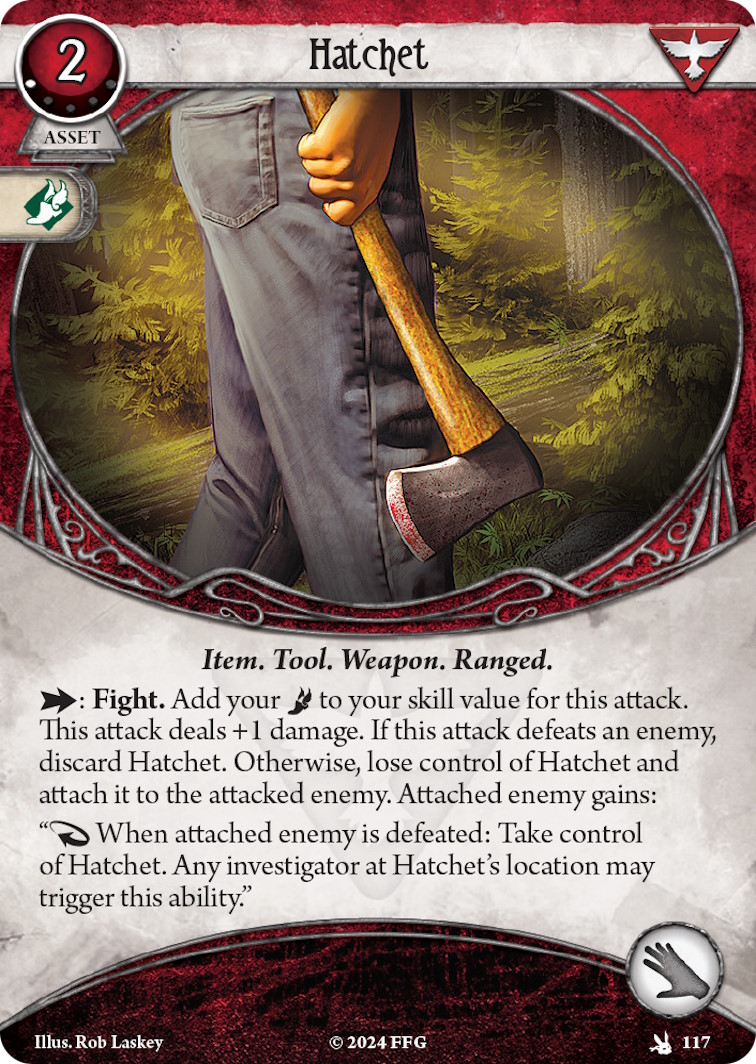
Hatchet / Archetype: Agility matters, Recursion
Adding the agility to the fight test is quite powerful for a level 1 card.
The funny thing is that you can only use Hatchet once per enemy. It will either be held for the rest of the fight, or in your discard if you killed the enemy.
To remedy that, your investigator must have other way to finish enemies off. Daniela and Rita abilities are both good in that perspective. I am not 100% sure about it, but Long Shot might also work to avoid the discard.
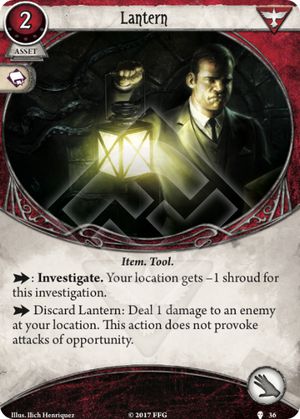
Lantern / Archetype: Recursion
Lantern is one of the most expensive way to deal one damage, with a cost of two actions, 2 resources, and a card.
The damage dealt is however guaranteed, and does not require to be engaged to the enemy.
This card shines best in a Scavenging(2) deck. If you are using scavenging to recur and play the card, the damage now just cost 2 resources. Being able to reduce the shroud also makes scavenging easier should you have one in hand and one in the discard.
It is not the most exciting option, yet viable for Bob or Darrell.
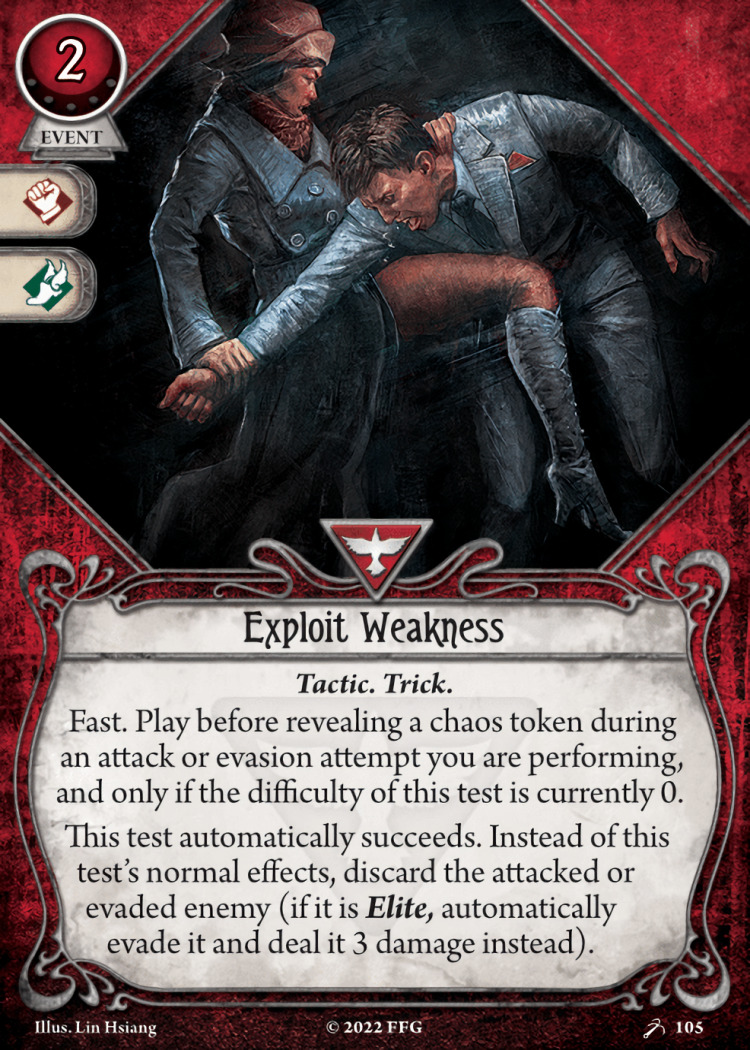
Exploit Weakness / Archetype: Test at 0
This card is amazing when played. A guaranteed defeat against an enemy, or a 3 damage hit against an elite is a huge payoff.
The difficult part is to get to play it when needed. For it to be consistent, you will need a fight/evade difficulty reduction of at least 2, as not that many enemies have 1 in one of their stat (with a notable – spoiler – exception).
In solo, with a bit of XP Flashlight(3) is a versatile option. At level 0, oddly enough, the best options are outside the survivor class. You can find a full interaction list on the ArkamDB page and on Reddit, but the most notable are Toe to Toe which guarantees a 5 damage hit on an elite, Stealth or Anatomical Diagrams (works only on non-elite though)
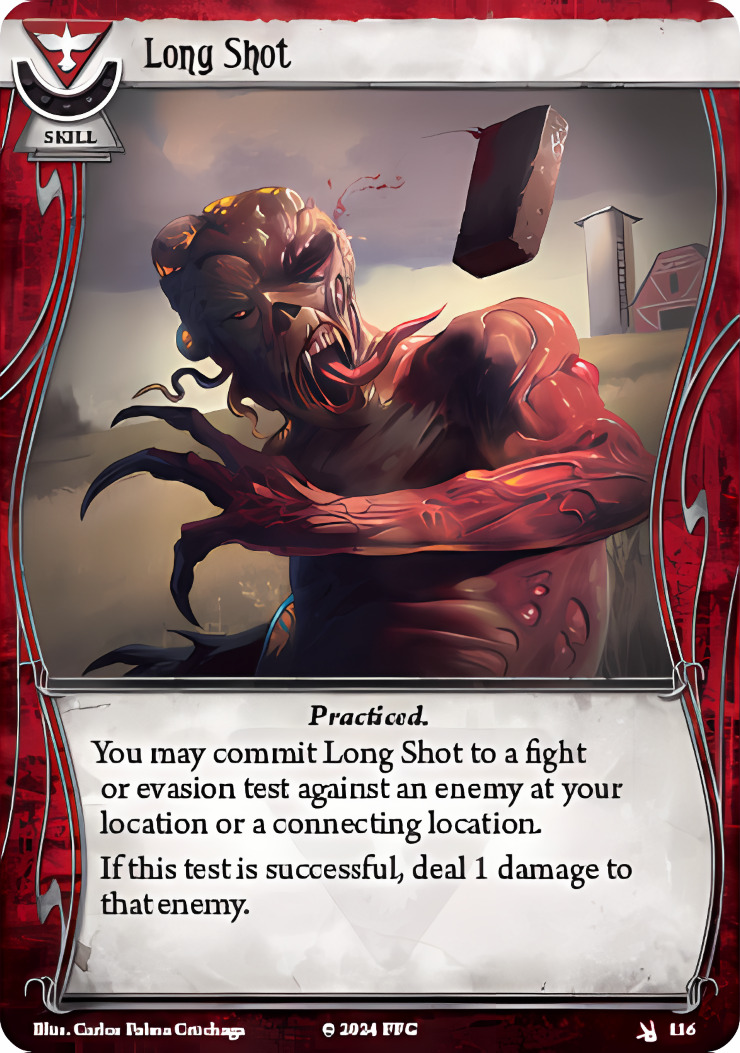
Long Shot / Archetype: Evading matters – Use another stat
Long Shot is not a standalone solution to defeat an enemy. Its purpose is instead to add damage to another effect.
Because it has no icons, it is quite versatile at doing so.You can commit this to a Shrivelling fight. You can add another damage to a Cheap Shot or a Blinding Light. You can boost a “I’ve got a plan” or a British Bull Dog attack.
It is very good with the Enchanted Bow as you can add damage when fighting an enemy at a connecting location.
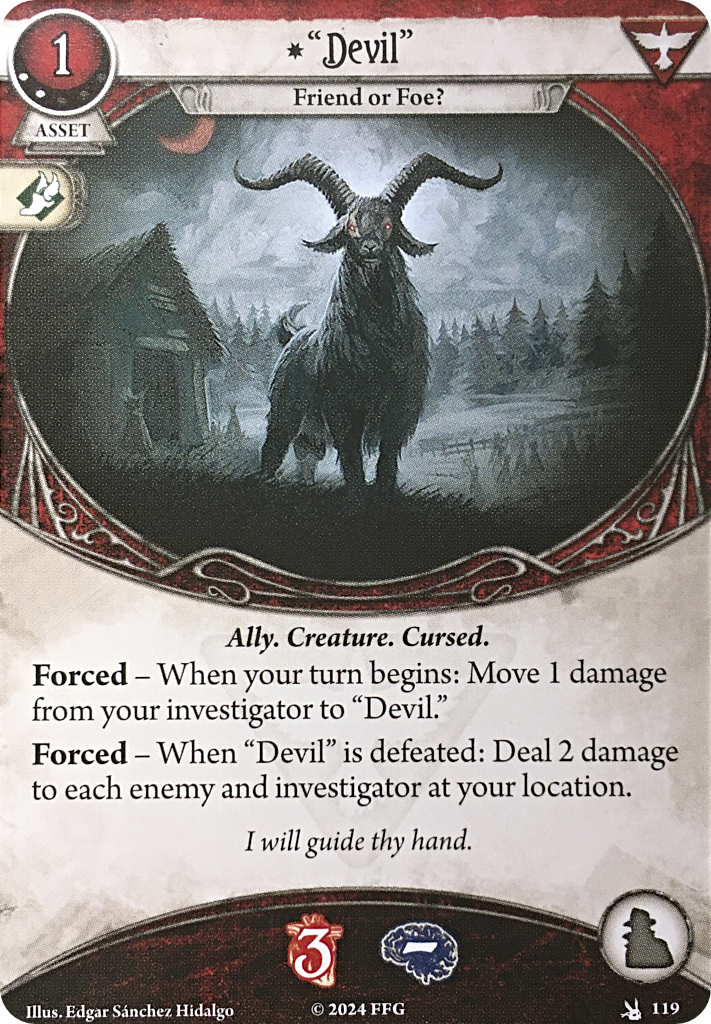
“Devil” / Archetype: Soak-Tech
Devil is an exciting card,. Effectively, it soaks for 1 (heal 3 – deal two), and deal a testless AoE 2 damage for 1 resource, a card an an action, which is very decent for a 2XP card.
The issue is that you want to absolutely avoid having the Devil bomb you with no enemies in play. It also will trigger attacks of opportunity and loose some value if you are already engaged to an enemy. The best use is to either play it when you know you will have an enemy at your location soon (either because it spawn in a location you want to move into, or because of the agenda flip), or to avoid having more than 2 damage on yourself to move to Devil.
Survivors have to rely on a small set of cards with very diverse mechanisms. Most of the card presented require some sort of combo to work. Survivors wanting to avoid testing fight will have to spare deck space, cards and resources for the enemies they really want to kill. They will often also have to use evasion and multiple different damage source to grind down chunky enemies.
Honorable mentions : Elaborate Distraction, Waylay (cannot defeat elites)
Outro
Because enemies dictate the pace of the game, investigators need a plan to address them. Defeating them is only one of the options available, but it is critical for True Solo investigators to be able to at least defeat 6-10 HP worth of enemies. You can target the lower end if your investigator is very good at dealing with enemies otherwise, and should shoot for even higher than 10HP if your only way to manage enemies is to defeat them.
The reason is that not being able to do so will outright loose some of the scenarios with a boss. In the other scenarios, it can be used to target VP enemies, or enemies that are hard to manage otherwise.
The common thing about the cards presented are that they are either costly, with a limited use, or a bit janky. This means that to achieve the 6-10 HP goal, the investigator will have to use a fair amount of resources and deck space.
During the game, investigators have to be very mindful of what they have in their deck, and use their resources carefully. Spending a Spectral Razor on the first 2/2/2 enemy that pop out of the encounter deck might leave them without options when the hard enemies show up.
Unfortunately, because of this scarcity, the variance for investigators with a low fight stat is usually higher. Missing a Backstab or a 4 damage “I’ve got a plan” can lose you a scenario, it’s just something you have to accept. Your goal is to make that as unlikely as possible with a clever use of your resources.