Evaluation of treacheries in the player resource trade model
In a previous post, we discussed a way to rate enemies through the amount of resources taken out of the player hands to defeat them.
Treacheries have a similar effect. They tax player resources in various ways: dealing damage and horror, making the players drop clues, loose actions, discard cards, etc. They differ from enemies as they have a much greater diversity in the way they operate. In this post, I propose to use the resource trade model to assess the severity of treacheries.
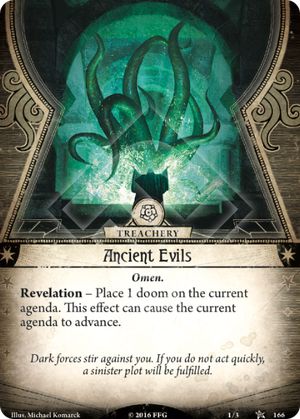
Categorizing the treacheries
Treacheries can hinder players trough different methods. In order to rate them, we first need to categorize the treacheries.
One time cost
These treacheries have a revelation effect that does not involve any test, and is immediate. Sometimes, the player gets to choose between two options.
In the core set, Ancient Evils or Offer of Power are examples of one time cost treacheries. Evaluating them is just a matter of quantifying what is lost by the player.
On-failure cost
These treacheries have the investigator take a test, and deal an immediate effect if the investigator fail.
In the core set, Crypt Chill or The Yellow Sign are examples of on-failure treacheries. Evaluating them is a bit more difficult, as one needs to balance the cost of passing the test vs the cost of the effect.
Fail-by cost
These treacheries are a variation of the previous category. They also come with a test, but the effect depends on how much the test is failed-by.
In the core set, Rotting Remains or Grasping Hands are examples of fail-by treacheries. Evaluating them is similar to on-failure treacheries, except that the optimization problem is different (balancing the cost of improving the investigator skill value vs the effect).
Lasting Treacheries
These treacheries enter the threat area of a player or are put in play on the board, and stay there until their discard condition is met. They are way more diverse because both the effect and the discard condition can be different.
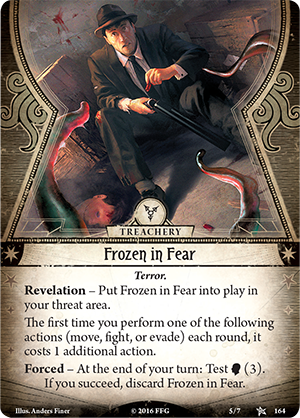
Some, such as Dissonant Voices in the core set, discards at the end of the turn or round. Some, such as Frozen in Fear, discards if the player succeed at a skill test at the end of the round. Some, such as Dreams of R’lyeh, require both an action and a test to discard.
Because of this variety, the evaluation method will differ for each.
Others
They are plenty of treacheries hard to categorize, as their effect can be tied to the scenario itself, or act as payoff or set-up for other treacheries.
These treacheries are much harder to consistently rate in the model. Their severity is better assessed based on player experience.
Illustration : rating treacheries of the Core Set
Treacheries of the Core set are relevant to use as an example, because they both provide a good example of the variety of effects, and many are used time and time again in the various campaigns of Arkham Horror LCG.
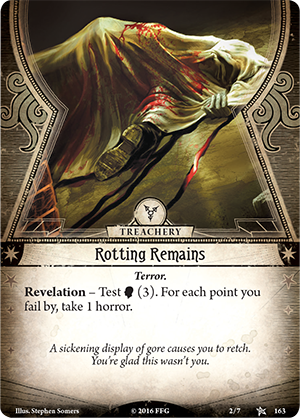
Category: fail-by cost
Taking an investigator with an average willpower of 3, the expected loss for a standard night of the zealot chaos bag is around 1.4 horror for a model cost of 2.1R.
By boosting the skill value to 4 (for a model cost of 0.75R), an investigator can lower the expected horror to 0.75 and the total expected cost to 1.9R.
Overall rate: 1.9R
Note that if the investigator has a low willpower, the expected cost will be higher (to a maximum of 4.5R)
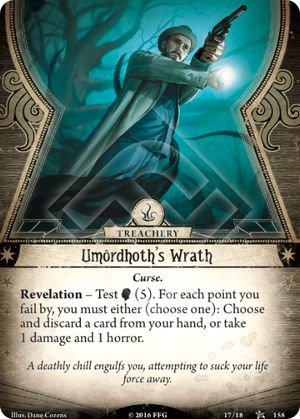
Category: fail-by cost
Taking an investigator with an average willpower of 3, the expected loss for a standard night of the zealot chaos bag is around 3.4 cards for a model cost of 5R.
By boosting the skill value to 5 (for a model cost of 1.5R), an investigator can lower the expected card loss to 1.3 and the total expected cost to 3.5R
Overall rate: 3.5R
Note that loosing a card is the less expensive option in the model, compared to taking 1 damage and 1 horror.
Category: lasting
Frozen can take up to one action, plus one additional action each time the test is failed. This is similar to fighting a one hit enemy, and the optimum is reached by taking the tests at +1, for a total cost of 4.9R
Realistically, the action will not be lost every turn but more in the vicinity of 80% of them, so the cost is a bit lower.
Overall rate: 4R
Note that for a lower willpower investigator, the expected cost is much higher
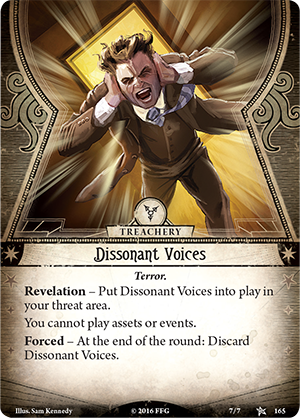
Category: lasting
The cost here is quite abstract. The investigators doesn’t loose anything, it just restricts their options. Sometimes, it won’t affect play at all, while it can be quite annoying if you rely on a big event to manage an ongoing fight.
Estimated rate: low threat = 1.5R
Category: one time cost
Ancient evils is quite specific, as its cost is tied to both the number of investigators, and the rest of the encounter deck.
What it does is to remove a round of play. For the investigators, that’s three lost actions, as well as one resource and card from the upkeep phase (total cost = 3*2.5+1.5+1=10R per investigator). However, they do get one less encounter card. Assuming that the average loss due to an encounter card between 3 and 5 (accounting for enemies), the cost of ancient evils becomes 5-7 R per investigators in the game.
Model rate: 6R per investigator in the game
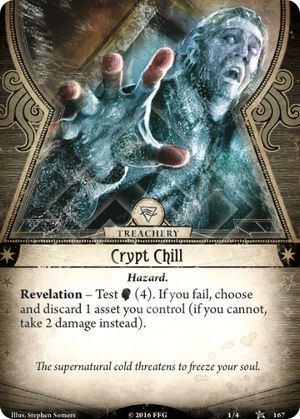
Category: on-failure cost
Crypt chill is only as bad as your worse asset. Sometimes, it will just discard a depleted flashlight and won’t matter. If the asset did matter, by loosing it, you effectively lose the action to play it, the card, and its resource cost. Taking an average cost of 3 resources, that’s a total of 7R lost on failure.
For an average willpower of 3, this translate to an expected cost of 3.6R, by boosting the skill up to 6.
Model rate: 3.6R
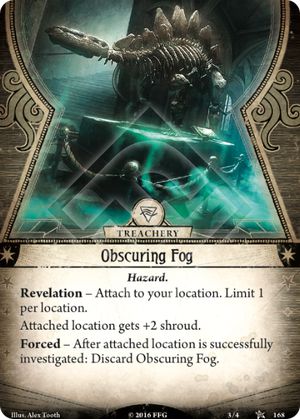
Category: lasting treachery
If their is no clues on the location, this is a blank. Otherwise, this will increase the difficulty of investigations by 2 until success. This equates to a cost of around 1.8R on average.
If we estimate that locations are empty 1/3rd of the time, the cost becomes 1.2R
Model rate: 1.2R
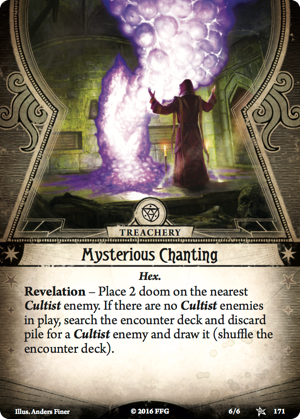
Category: one time cost
Another treachery not easy to quantify. Sometimes, it will add doom to a cultist you were going to kill anyway. Sometimes, it is an extra cultist.
Estimated rate: mid threat = 2.5R
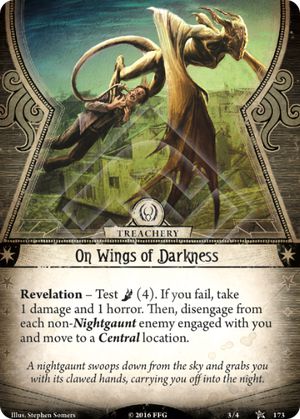
Category: on-failure cost
This treachery, as for Crypt Chill has a failure penalty that depends on the situation. Failing the test will at least cost 3R (1 damage and 1 horror), and additional actions if you get moved to an unwanted location. In some rare instance, the second half can even be beneficial. Assuming the extra loss is of 1 action on average, the total expected loss for a investigator with 3 agility is 3.3R (boosting the agility up to 6).
Model rate: 3.3R
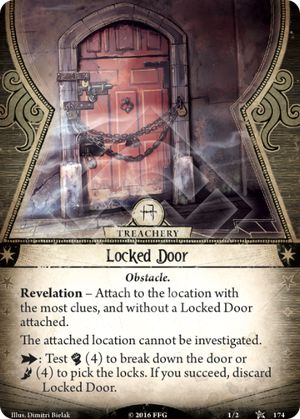
Category: lasting treachery
This treachery is either a blank if you don’t need to investigate the location, or requires to pass a difficulty 4 test by spending an action.
This, for an investigator with a skill of 3, equates to a cost of 5.8R (testing at +2).
Considering that 1/3rd of the time, the test can be avoided, this equates to an average cost of 3.9R
Model rate: 3.9R
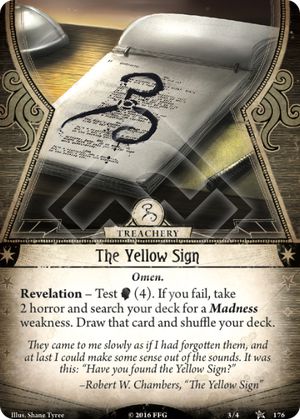
Category: on-failure cost
The cost of this treachery depends a lot if you have a Madness in the deck or not.
If you don’t, that equates to an average cost of 2.6R for a 3 willpower investigator (testing at -1). If you do, the cost ramps up to 3.8R (testing at +2).
Model rate: 3.2R
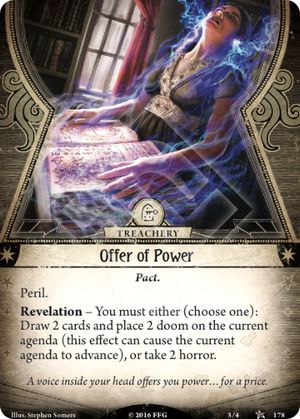
Category: one time cost
Taking the horror has a model cost of 3R.
Taking the doom is a very bad option if not playing True Solo. In true solo, taking two doom and cards has a total cost of 7R (two ancient evils at 5, and two cards at 1.5). However, if you get this on the turn before the agenda advance, the effective cost becomes 2R (one ancient evil, minus two cards). This is quite a rare situation however.
Model rate: 3R
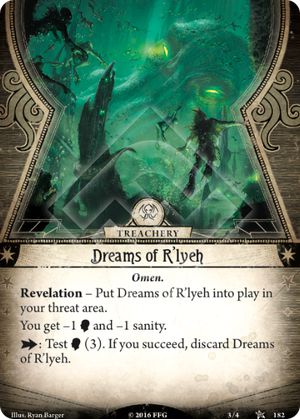
Category: lasting treachery
On the last rounds of a scenario, this treachery might be ignored, and then acts a a single point of horror.
If you want to get rid of it, the cost equates to passing a difficulty 4 test, which has a cost of 5.8R for an investigator with a base skill of 3.
Assuming you want to get rid of it 2/3rd of the time, the model rate is:
Model rate: 4.8R
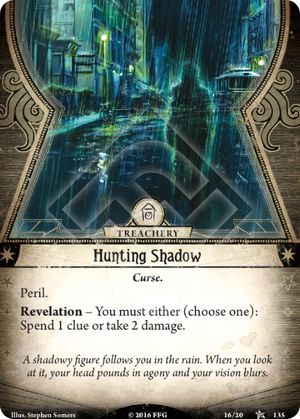
Category: one time cost
Hunting Shadow has the player choose between spending a clue (rate: 3.5R) or taking 2 damages (rate: 3R).
The rate difference means that most investigator will prefer to take the damage if they can afford to. The fact that the clue is not just dropped on the location but spent also makes loosing a clue worse.
Overall rate: 3R
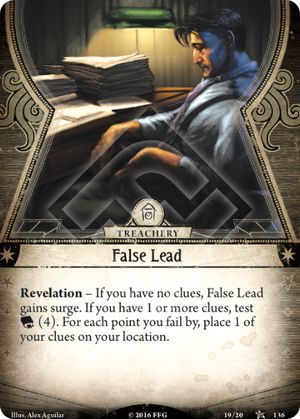
Category: fail-by cost
Here, the loss potential is directly dependent on the number of clues that the investigator has. If the investigator has no clue, it surges, and its values becomes the average value of the rest of the encounter deck (average estimated at 5R with enemies).
If the investigator does have clues, the cost for an investigator with 3 intellect ranges from 3.3 (testing at -1) with only one clue to 3.8R (testing at +2) with four clues.
Overall rate: 3.5R
Conclusion on treacheries
Looking at the treacheries in the core set, it appears that the model cost of a treachery usually range between 1.2R for the easiest and 5R for the hardest in the Core Set (which equates to 0.5 to 2 actions).
Compared to the rate of the enemies in The Gathering alone, we can clearly see that treacheries are on average way less potent than enemies at draining player resources. A mere Ghoul Minion is a bigger threat than most treacheries.
A notable outlier for the Core Set is Ancient Evils. In True Solo, at 6R it remains a solid treachery, but is outclassed by many enemies. But because the rate scale with the number of investigators, in a four player game a single Ancient Evils can take out 24R out of the team. This is why it is such a great target for a Ward of Protection.
Speaking of Ward of protection(0), the cost of warding a treachery is 1 card, 1 resource and 1 horror. This has a rate of 4R. It is well balanced, as it means that most treacheries are not worth warding (unless they attack something you are especially weak at). The difference in effect of treacheries and enemies also explains why Ward of protection(5) is worth the extra XPs.
Now that we way to rate all the card in the encounter deck, the next step will be to combine everything we modeled so far to construct a scenario difficulty model.