Purpose and implementation of the XP system in Arkham Horror LCG
In a cooperative board game, players play against the game and not one another. The lack of human competition is an additional challenge for the game designers. indeed, in a competitive setting, the game remains interesting as long as players have decisions, and as long as players have a comparable skill level. In a cooperative setting, the difficulty balance is key to keep the game engaging for the players, as designers cannot rely on the wit of the opposition to challenge the players.
In Arkham Horror LCG, the difficulty balance of a given scenario is piloted by three different factors:
- The game difficulty setting, which affects both the chaos bag and the value and effect of scenario tokens.
- Set-up conditions that depend on the outcome of previous scenarios.
- The deck quality of the participating players.
As the difficulty setting is mostly static (decided when a campaign begins) , and the set-up conditions are scenario specific, the improvement in deck quality is both the easiest way for players to feel their progress in a campaign, and for the designer to evaluate how difficult their scenario need to be.
In Arkham Horror LCG, players deck are improved through the experience(XP) system.
In this post, we will examine what the XP system brings to the game, how XP interacts with difficulty scaling and players success rates, how is XP earned, and finally, review the tools available for players to generate more XP in the context of True Solo play.


Why have an XP system in a game like Arkham?
As it is a system unique to Arkham, one can think about the purpose of the system and what it brings to the game.
If you consider playing a single scenario (even playing the standalones), then Arkham doesn’t stand out compared to other “deckbuilders”. In this type of games, players are required to assemble a static deck before using it to either complete a challenge offered by the game (LOTR LCG) or defeat other players (Androïd Netrunner LCG, Legend of the Five Rings LCG).
In Arkham, XP is what ties scenarios together. It offers player the opportunity to modify (and improve) their deck between two scenarios in a campaign. The difference with games like LOTR LCG, in which you can rebuild a deck for each scenario, is that the XP system sets a limit to the modifications you can do.
So, XP is what allows us to modify our deck in-between scenario. But the game could just have given us the equivalent of 2X Adaptable, and function without XP. What does XP brings on top of this?
The first difference is that XP is earned. It is a good metrics of how well did the players do in a given scenario. For players that care to win campaigns, gathering as much XP as possible is probably the best strategy in all scenarios but the finale of each campaign. XP reinforce the influence of past scenarios on the play of the next ones, often more than journal entries and scenario resolutions.
The second improvement is that XP offers a sense of progression. The game could have been designed with campaigns of scenarios of similar difficulty from the beginning to the finale. In Arkham, they become gradually harder (worse chaos bag, more challenging tests, etc), and your deck is expected to have gathered enough XP and field better cards to beat them.
One could say that on some level, XP is a clever way to exploit our psychology to cheaply expand the card pool. After all, Testing 6 vs 2 with Shrivelling on an early enemy is mathematically identical to testing 8 v 4 with Shrivelling(2) in a later scenario (assuming the same chaos bag). But it makes us feel stronger. -numbers big, huh- . Fortunately, adding XP to cards do not simply feed into our inner Timmies, it also opens new cards interactions, either unique and creative (Johnnies) or simply effective (Spikes).
How does XP interact with the game difficulty and balance?
In my work of theorizing Arkham, I created a model to evaluate the difficulty of a scenario. In essence, it compares what the players are given to perform the tasks of the scenarios, and the difficulty / volume of the tasks.
While I have yet to model more scenarios to prove it, I expect the difficulty index of scenarios to increase along a campaign. There might be difficulty spikes in certain scenarios of some campaigns, but on average, I expect finales to have a higher index than the first scenarios. This is the consequence of multiple factors:
- Chaos bag difficulty: in the course of a campaign, multiple scenario chaos tokens are added, that tend to have either worse than average negative modifier, or strong negative on reveal / on failure effects.
- Test difficulty ramp-up: while not true for all campaigns, some of the later scenarios feature tests of higher difficulties, especially on in the encounter decks. A good example from the Core Set is the comparison between a Rotting Remains and Umôrdhoth’s Wrath. This is however not systematic, as for example Shroud Values in The Dunwich Legacy are fairly constant across the campaign.
- Tasks volume: Later scenarios can require to collect more clues, defeat enemies with larger health, perform more actions, etc.
XP is the main tool for players to compensate this difficulty increase. Cards of higher XP level have better value. When I evaluated the cards that allowed to trade between game resources, I showed that while level 0 cards are on average valued at ~1.5 resources, for events, each XP invested would add on average ~1 resource of value to the card.
While the details of the decks and their synergies / strength and weakness matters, ultimately, this value difference is why it is easier to beat a scenario with a 40XP deck than a 15XP deck.
This creates a key characteristics of Arkham Horror LCG, which is that it is a snowballing game. The better player do in early scenarios, the better their decks becomes, which in turn makes them more likely to gather more XP on later scenarios, etc. On the opposite direction, a bad start can spiral into difficult scenarios, up to the point where the finale has very little chance to be won.
How is XP won, and should it change?
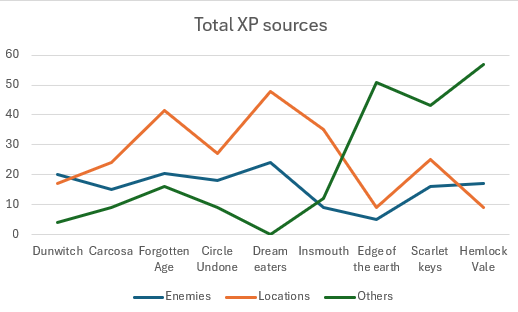
First and foremost, I’d like to thank DerBK from Ancient Evils for the amazing job in collecting XP data from all the campaigns. It really made writing this easier.
As of today, players can gain XP both during the play of a scenario, or in-between scenarios.
During the play of a scenario, XP are gained through one of the following:
- Clearing clues out of Victory locations
- Defeating Victory enemies
- Player cards that grant additional XPs
In between scenarios, XP can be obtained by:
- Bonus XPs from scenario resolutions
- Player cards that grant additional XPs (or discount upgrading cards).
- XP granted by the campaign guides during interludes / off scenario readings

- Having XP tied to tasks specific to the scenarios is more immersive than collecting generic VP out of locations or enemies.
- Having XP tied to out of play decisions can create meaningful decisions, especially if they are balanced by an opportunity cost (such as getting XP vs getting a story asset, or getting Cookie’s XP vs removing a Frost Token in Edge of the Earth).
- Giving XP that is not tied to how player performed in scenarios reduces the snowballing effect. It also ensure that player can still see their deck evolve even if they fail the scenarios.
- This is however to use with caution, as an excessive distribution of XP removes a lot of the rewarding feeling of doing well in a scenario.
Getting XP through player cards
From the discussion above, I excluded the use of player cards to get XP.
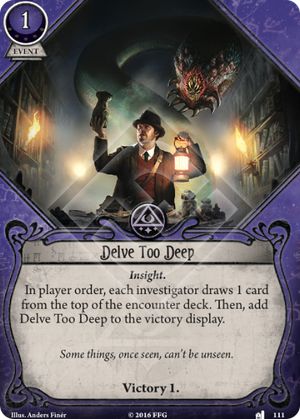
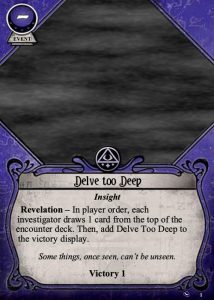
In The Dunwich Legacy, with the introduction of Delve too Deep, players got their first tool to generate additional XP. Since then, players received a fair number of other cards that generate additional XP.
I will present and detail each of them, but for the most part, these cards either grant the XP in exchange of another player resource, create a sort of “minigame” to be solved within a scenario, or are permanent cards that impose some kind of restrictions to the player.
In a min-maxing perspective, using these cards makes a lot of sense. XP is what wins campaigns, and any XP that you can get on top of what the campaign offer puts you ahead of the balance curve. Sadly, this means that these cards create a situation where players can increase their chance of winning the game by not playing it. Sometimes, it’s just easier to play Delve to Deep and resign than to get to that last VP location with a Locked Door and clear it.
These cards also break the balance when introducing side scenarios into a campaign. These scenario had an XP cost to be played, and you had to perform well in them to just get back to even, XP wise. With additional XP coming from player cards, the balance shift into the positive and adding side scenarios is an easy way to increase the XP total for the finale.
Ultimately, using these cards or not is a matter of personal choice, just as choosing with how many investigators to play or what difficulty to play at. You will see no judgement on my part. Personally, I tend to use these cards when playing solo, and they will figure in the decks presented on this website. But I completely understand why some cards may be frowned upon at a gaming table.
Evaluation of XP acceleration cards, in the context of True Solo play
In this section, I will review every cards that can be used to accelerate the XP density of True Solo decks. Some of them will figure in most of my decks, and some will never see use.
Investigator Signatures
S Tier
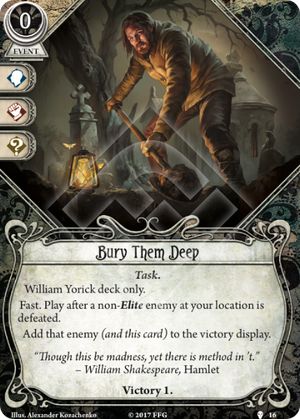
Will Yorick has the privilege of being the only investigator to have a -vanilla- signature that gives additional XP.
In most of the scenarios, if you see the card, you will get the XP. It just costs a card, it is fast, and you just need to defeat a non-elite enemy to play it, something Will Yorick both is good at and wants to do.
Cherry on the cake, the card will ensure this enemy is out of the game. In solo, the encounter deck is not likely to run out of cards, but it can be valuable in scenarios where the deck is reshuffled multiple times.
It can also lock away enemies weaknesses, like the Graveyard Ghouls.
B Tier
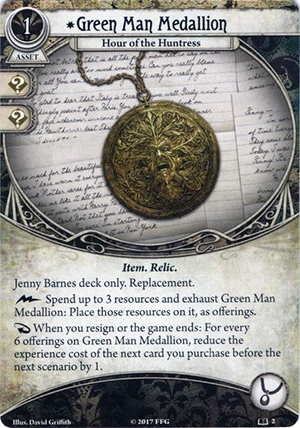
This card is a replacement signature for Jenny Barnes. While this card has the highest XP gain potential of the game as you could -in theory- get a 10XP card for free out of it, it does not really play well in Solo.
The cost of the first XP is quite high: a card, an action, and 7 resources is a lot (11R in my model). After that, each additional XP cost just 6R, a much better rate.
In multiplayer, it is easier to get ahead of the doom clock and cheese XP at the end of the scenario. In True Solo the doom pressure is much higher, an the timing window for greeding is not nearly as big.
This card also takes a valuable slot and comes with the Sacrificial Beast weakness, which in Solo can completely disable Jenny‘s ability to get resources. Without the two wilds, it would probably drop to C Tier.
Neutral Cards
S Tier
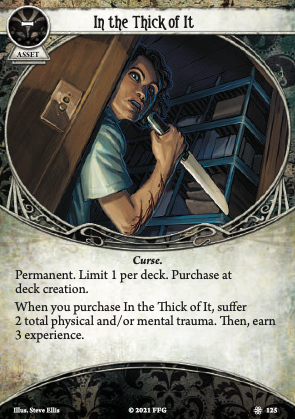
This card offers 3 additional XP in exchange for two traumas at deck creation. In my model, two health or sanity are worth 3R, and and 3XP adds about 3R to the deck, so it appears as a balanced trade.
However, in reality, the trauma will be often allocated to the pool you have in excess (Roland plays just as fine with 7h/5s than 9h/5s), while the XP will be used to by cards with way above average value and investigator synergies.
The result is that for me, I now only consider NOT taking the card when I actively intend to use my health / sanity (Mark Harrigan being a good example). Or if I am already taking trauma from other source (2 from In the Thick of It and 2 from Arcane Research starts to pile up).
This card is so good because it places the deck above the XP curve from the start, which means it will be easier to collect XP from early scenarios as well.
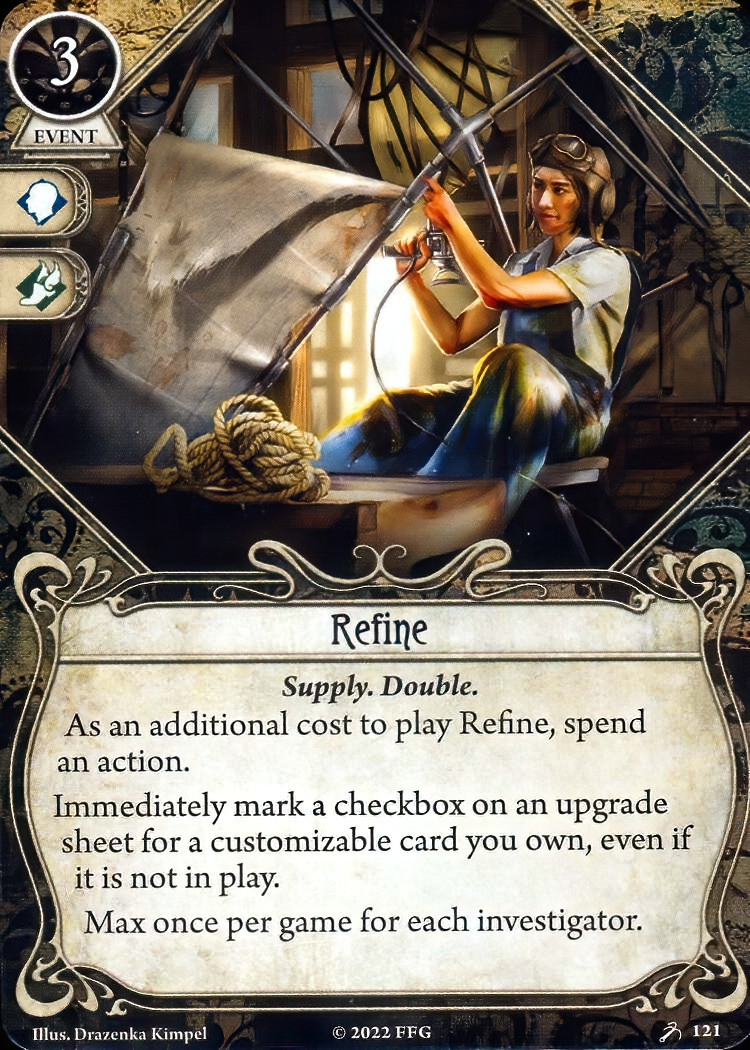
C Tier
This card face value is one XP for 3 resources, 2 actions and a card (9.5 R), a bad rate overall. It is slightly better than this as this XP usually will upgrade two cards in your deck.
The problem with Refine is that in Solo, it is hard to find a quiet turn to dedicate to it, and there is no guarantee that you will have enough time to play it in the end of the scenario.
The fact that it has icons is both a boon and a curse, as I am often quite tempted to (and sometimes do) commit it to an important test.
I still take a 1-of in some of my decks with customizables, but it never felt amazing.
Guardian cards
It is a cruel but true statement. Guardians are now the only class with no XP acceleration whatsoever. I hope they will get something out of The Drowned City.
Seeker Cards
A Tier
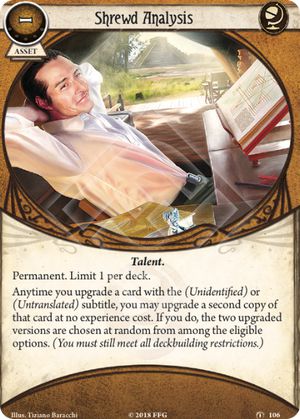
The intended effect of Shrewd Analysis is to upgrade two cards for the price of one, with the caveat that you have to select at random among the available options.
It see three use cases for the card:
- The investigator deckbuilding restrictions only allow for one of the upgrade options (Ancient Stone for Carolyn, Strange Solution for Vincent). In this case, it’s a free 3-4XP.
- You want an upgrade but don’t really care about which one. A good example is Dream Diary, where the 3 upgrades at least provide the Unexpected Courage every round.
- You want a permanent that does nothing. This is helpful to satisfy Lola Hayes deckbuilding restrictions, and to trigger Synergy cards effects.
None of these are particularly broken, but when you want it, it costs absolutely nothing to get.
C Tier
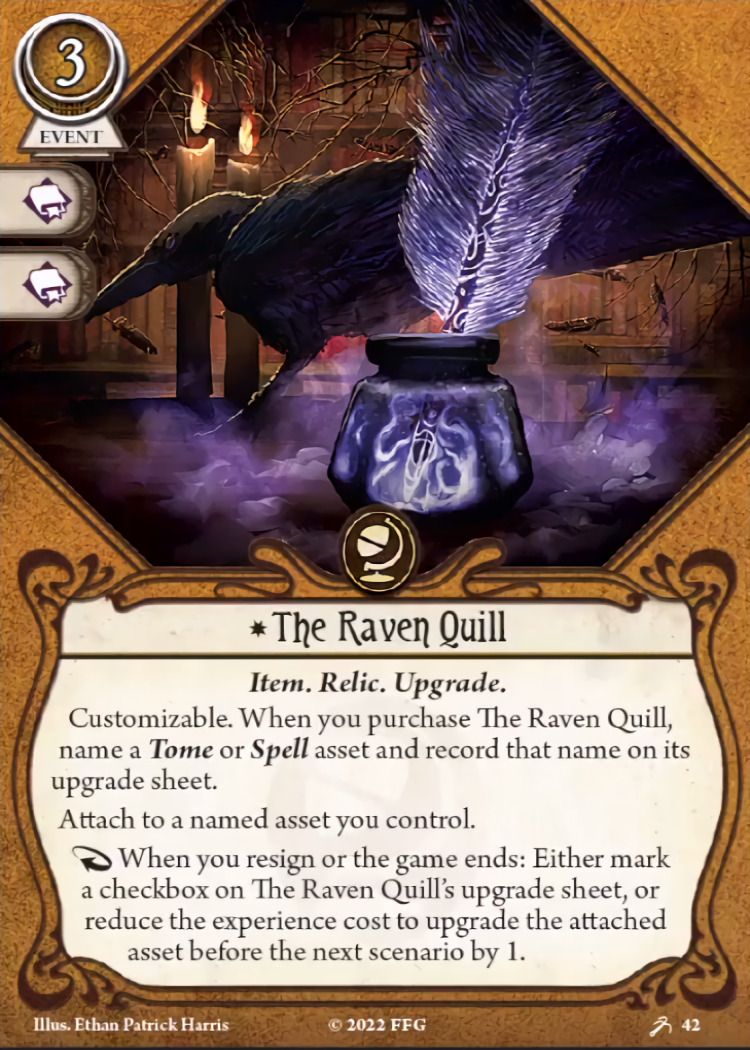
“Hey, a card that upgrades itself when you plat it, sound good, right?”
The fact is that, even at level 10, this card is not incredible. Each of the effects are individually good, but none of them are that so enticing that paying 3 resources, a card and an action for it sounds like a bargain.
It work best for assets you would like to keep in the deck from scenario 1 to the finale. To justify the cost, you also want a lot of mileage out of the said asset. For me, the most likely candidate is Grim Memoir, for Daisy, with ways of adding secrets to it.
Rogue Cards
A Tier
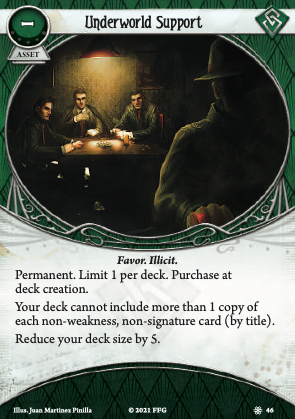
“Wait, but this card does not give any XP!”
True, but it kinda does. Because this card makes your deck smaller, each XP you spend on other cards has more impact on your deck average value.
At level 0, it is actually a negative, as your deck is now more dense in weaknesses. With 10XP in the deck, the average value of the deck is about equal with/without Underworld Support. At 29 XP, the difference is notable as your XP is split between 30 cards in one case, between 25 in the other. The more XP you get, the better it becomes.
A Tier
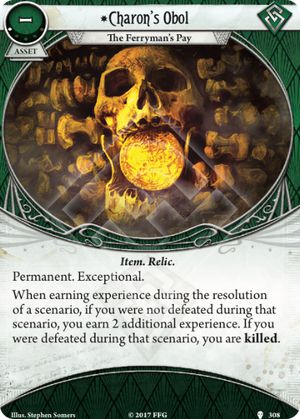
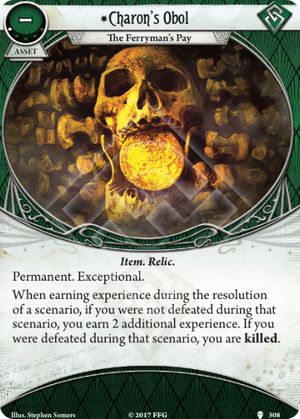
Let’s not pretend this card will never kill you. It will.
The math on the card is not simple. It will sometimes reduce your chance to get to the finale (or have you reach the finale with a new investigator with low XP), and the rest of the time, you will get to the finale with 12 more XP (assuming you take it with in the Thick of It).
Does this increase / decrease your probability of winning a campaign?
I am waiting for more stats on my plays to give my verdict, but I suspect it improves your winning probability quite a bit. If you manage to survive, having more XP from scenario 3 to 8 will also help you collect more XP than decks without the Obol.
D Tier
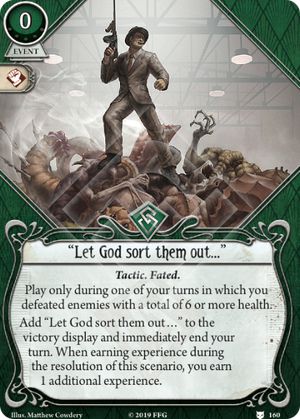
This require so many stars to line up to be played that it is just not worth taking. In True Solo, you very rarely encounter single enemies with 6+ HP that are not scenario-ending bosses.
Even if you find yourself with multiple enemies, then your priority is to defeat/get away form them ASAP, a task that is already challenging for a lot of investigators.
Killing them with one action to spare is a nice fantasy. It just never happens.
I might take this card for The House Always Win with Tony Morgan, but that’s about it.
Mystic Cards
S Tier
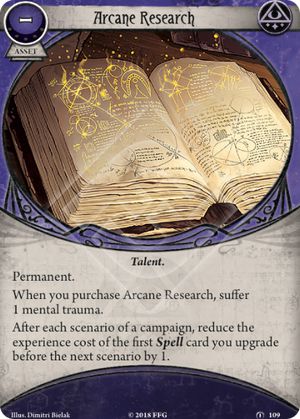
7 XP of value for 1 mental trauma is just insane. Getting to take two of these for 14XP total is just insanely strong.
To make full use of the card, you need to have 7 spells to upgrade during the campaign. That is really not that difficult considering that multiple spells have two upgrades each.
While this card is rarely good in off-class Mystics, it is -almost- a mandatory pick-up for the primary Mystics. Agnes Baker might be a bit more reluctant to take it, as it reduces the room to use her ability.
S Tier
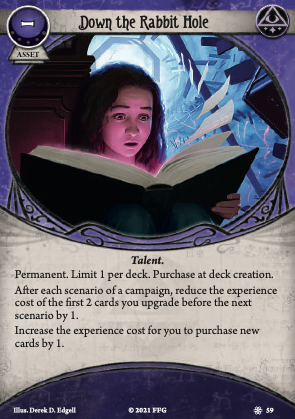
Liked the 14XP for 2 traumas? How about 14 XP for free?
Down the Rabbit Hole, in the modern card pool, is, by far, the strongest XP acceleration card in the game. It is entirely possible to field decks with 14 upgradable cards.
Of course, most of the time, you will want to add some new cards to the deck as well. My standard pace is to upgrade 2 cards and buy one new every scenario, which still leaves me with a net 7 XP for absolutely no cost.
While Arcane Research is very powerful for Primary Mystics, I take Down the Rabbit Hole in almost any deck that can take it.
B Tier
The first card to break the XP curve is unfortunately not the best in True Solo.
The fact that it actually gives Victory 1 and not reward individual XP only matters in multiplayer. The golden hour for Delve Too Deep, which is to play it at the end of a scenario before resigning/advancing, is not so easy to find as time is more pressing in True Solo. Finally, the fact that it is a dead draw until used is also more significant, as True Solo decks are tight with little room for unusable cards.
Being the same class as Down The Rabbit Hole is also a drawback, as 2 of the earned XP will be removed when replacing Delve Too Deep by new cards for the finale.
Survivor Cards
B Tier
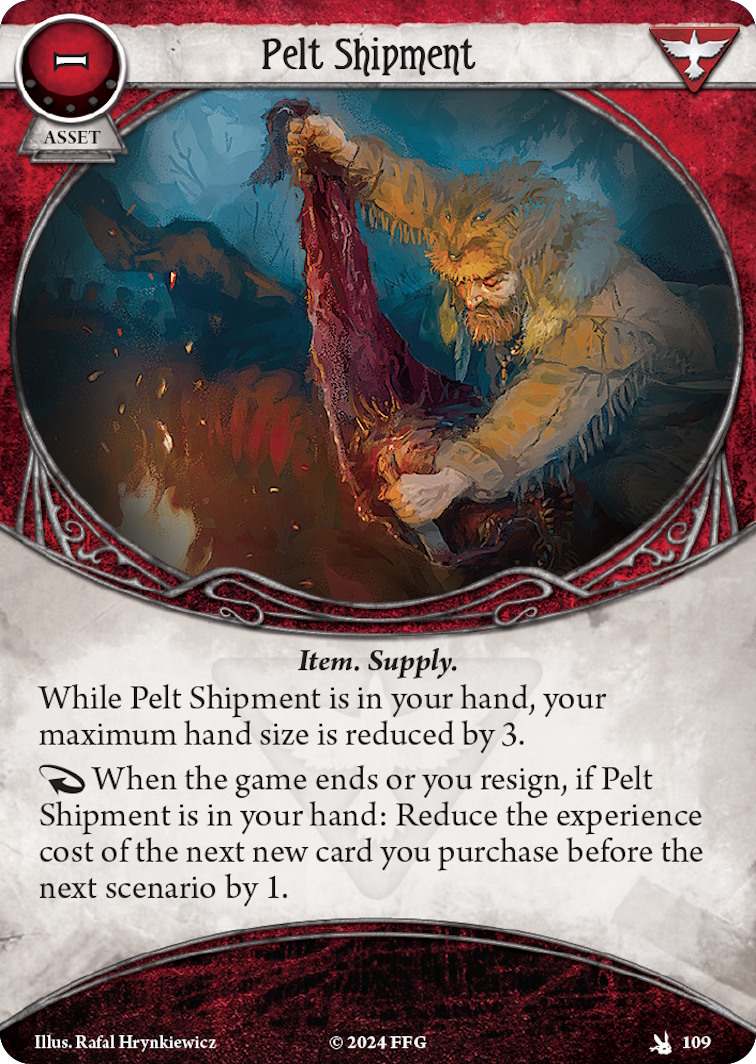
This card is a fresh new addition to the game. Just as Delve Too Deep, it is mostly a dead draw. The main difference is that while you need to hold onto Delve until you play it, the best place for Pelt Shipment is actually your discard pile. The fact that it reduces hand size mean that it is more likely to trigger discards in the upkeep phase, at what point I would pitch Pelt Shipment without remorse. It is also a great fodder for treacheries, or Wendy‘s / Ashcan’s abilities.
Just as Delve Too Deep, I would not play Pelt Shipment in Down the Rabbit Hole decks. However, it really shines in the decks that are using a lot of recursion (Will Yorrick/Scavenging), as picking it back just before closing the game is the best way to use it.
D Tier
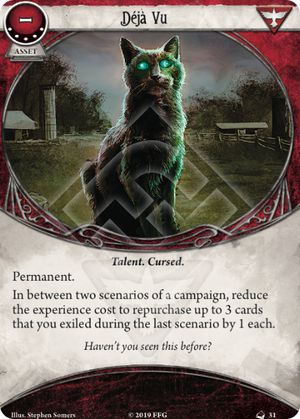
The promise of this card is to give you 3XP worth of exiled cards after each scenario.
Unfortunately, exiled cards are not that good, and their best use is to dump your last XP in them for the finale.
The fact that Deja Vu cost 5 XP means that you probably only want to invest into it if you can field 3 exile cards immediately. That’s a 8XP minimum investment. The same XP spent elsewhere will almost certainly make the deck much more likely to succeed. To me, this is a hard pass.
And, that’s about it. Not that many cards, but they changed the game forever.
Today, a Dexter Drake can, as long as he isn’t defeated, gain 6 points worth of XP out of Charon’s Obol, Down the Rabbit Hole and 2X Arcane Research. It is more than what a lot of scenarios give.
Looking at the cards, it seems that today, the only class that still struggle with XP are Guardians. Seekers have great cards from level 0, Survivors do not need that much XP to get going, and Rogue and Mystics have the best XP accelerations cards.
Wrapping up: my wishes for the evolution of the XP system
Now that I presented the system, how would I like it to evolve over the next few years? Here is my wishlist:
XP aquisition
- I feel that there is enough XP in the vast majority of campaigns, and if not, it is easily compensated by XP acceleration cards. During my last run of Dunwitch with Tony Morgan, I started the last scenario with 50XP in my deck despite loosing 3XP to a Brood.
- Personally, I would like XP acquisition to be limited to either scenario play (VP enemies, locations, player cards), or scenario resolution. I don’t like XP being added during interludes.
- I would love to see some VP treacheries in some campaigns. Big, scary treacheries with a difficult test that are added to the VP display once resolved.
- The game should not give “Pity” XP, as it removes value from the XP earned by play. I personally don’t mind face-planting a scenario. To implement a catch-up mechanic, I’d rather have campaigns give unique story cards to failing players, or add collectable XP in the next scenario.
- Player cards that give XP should be tuned to create extra challenges during scenarios, rather than being “free XP” (Down the Rabbit Hole, Charon’s Obol), or cheesed at the end of a scenario (Delve to Deep, Refine, Pelt Shipment). Just imagine how different it would be if Delve to Deep was designed as this:
Using XP
- Interludes in campaigns are a good place to spend XP in. I’d love the game to offer new story paths that you could invest some XP in unlocking, just as you spend XP to play a standalone in a campaign. It is also a good way to reward players doing “too well” while avoiding to trivialize the later scenarios.
- I would also love to have a “campaign player card pool” to buy cards from, with cards that thematically fit the campaign. It would enhance being unique decks around a specific campaign.
- I want more investigators like Lily Chen, that care about their XP total, or have unlockable perks with XPs.
And beyond it...
In the end, the XP mechanics brings a lot to Arkham Horror LCG. It successfully bridges the gap between pure deckbuilders and the traditional idea of levelling up your characters is a roleplaying game.
Looking at it from afar, the main drawback is that the XP system -can- somewhat dissociate the decks from the story of the campaigns. It is now not that hard with a lot of XP to build decks that are universally good, and don’t care too much about the specifics of a campaign.
While my personal wish would have been to tie the XP system more closely with the campaigns, the designers seem to have went for another route, in The Drowned City. They have built-in progression with the form of the Tasks, where you can unlock a Perk by performing in game actions. This is quite close to what I whished for, as it is very similar to hand you XP for in game play, and then have you invest it in campaign specific bonuses. I am quite excited for this!